Key takeaways
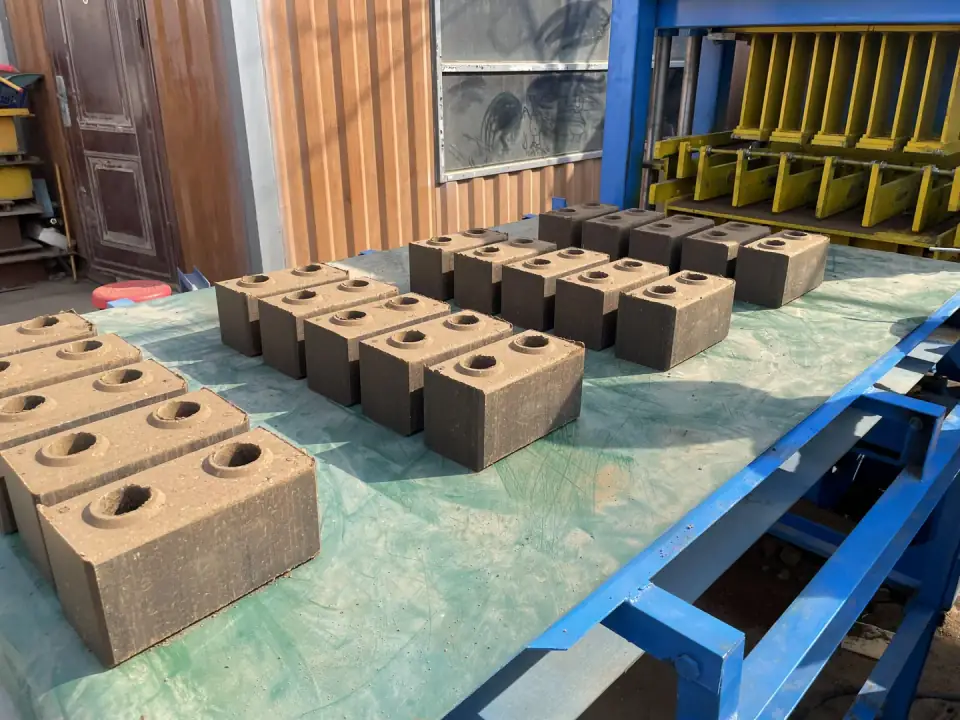
- Interlocking clay (CEB) bricks use local soil plus 5–10% cement, so material cost can be much lower.
- Concrete blocks are stronger and accepted by more building codes for multi-storey work.
- Interlocking walls go up faster and need little or no mortar.
- Many successful yards produce both — one machine each.
Both products are made by compaction rather than firing, and both can be produced with small investment. Which one suits your business depends on available raw materials, local building codes and who your customers are.
Raw materials
Interlocking clay bricks — also called compressed earth blocks (CEB) — use sub-soil with 15–30% clay content, stabilised with 5–10% cement or lime. If good laterite or clay soil is available on site, the main material is almost free. Concrete blocks need sand, crushed stone and 8–15% cement, which must be bought and transported.
Strength and codes
Stabilised CEB typically reaches 3–7 MPa — enough for one- and two-storey houses. Machine-made concrete blocks easily reach 7–15 MPa, and pavers 30 MPa or more. For commercial buildings or government tenders that specify concrete masonry, concrete blocks are usually required.
Construction speed
Interlocking bricks lock together like building blocks and can be dry-stacked, with grout only in vertical holes and ring beams. Masons build walls significantly faster, and mortar savings are substantial. Concrete blocks need conventional mortar joints.
Investment
A manual KDS2-40 or diesel KDS2-25D costs a fraction of a concrete block line and needs no grid power. For commercial CEB output, the automatic QTS5-10 adds conveyor feeding and hydraulic pressing.
Our recommendation
Choose CEB if you serve self-builders, NGOs or rural housing and have suitable soil. Choose concrete blocks if you serve contractors and commercial projects. If you are unsure, send us a soil sample photo and your target market — our engineers will advise.
Frequently asked questions
Do interlocking clay bricks need firing?
No. They are compressed and cured with a small amount of cement or lime, so no kiln or fuel is required.
What soil is suitable for interlocking bricks?
Soil with roughly 15–30% clay and the rest sand. A simple jar sedimentation test indicates suitability before lab testing.