Key takeaways
- A starting ratio for hollow blocks is 1 part cement to 6–8 parts aggregates by volume, with a dry “earth-moist” consistency.
- Pavers need more cement (about 1:3–1:4) and a well-graded aggregate for 30–50 MPa strength.
- Fly ash can replace 15–30% of cement once you have tested it locally.
- Always confirm a recipe with compressive tests at 7 and 28 days.
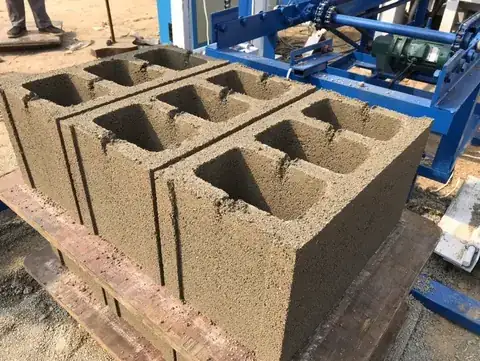
A block machine compacts what you feed it — it cannot fix a poor mix. Most quality complaints we investigate (crumbling corners, low strength, high breakage) trace back to the mix rather than the machine. Below are the starting recipes our engineers use when commissioning a plant, and the method to adapt them to your materials.
Earth-moist: the most important property
Machine-made blocks use a zero-slump, earth-moist concrete. Squeeze a handful: it should hold its shape without water dripping, and break cleanly. Too dry and the block will not compact; too wet and it will slump after demoulding or stick to the mould. The water-cement ratio is typically 0.35–0.45, but the right water content depends on the moisture already in your sand.
Starting recipes (by volume)
| Product | Cement | Sand (0–4 mm) | Crushed stone (4–10 mm) | Typical strength |
|---|---|---|---|---|
| Hollow block, non-load-bearing | 1 | 5 | 3 | 3.5–5 MPa |
| Hollow block, load-bearing | 1 | 4 | 2–3 | 7–10 MPa |
| Solid brick | 1 | 4 | 2 | 10–15 MPa |
| Interlocking paver (body) | 1 | 2 | 1.5 | 30–50 MPa |
These are starting points. Local sand grading, stone shape and cement brand all change the result. Batch by weight once production is stable — volume batching drifts with moisture.
Using fly ash and other supplementary materials
Class F fly ash from coal power plants can replace 15–30% of cement and improves surface finish. Ground granulated slag, stone dust and crushed construction waste can also replace part of the aggregate. Machines such as the QT10-15 fly-ash line have strong vibration specifically to compact these finer mixes.
How to test and adjust
- Produce 20 blocks from a trial batch and mark them.
- Weigh three blocks immediately — weight variation should be below 2%.
- Crush three blocks at 7 days and three at 28 days in an accredited lab.
- Adjust cement first for strength, then sand-stone ratio for surface texture.
Do not forget curing
Even a perfect mix fails without moisture. Keep blocks covered and damp for at least 7 days. Our guide to curing concrete blocks covers sprinkling, plastic sheeting and steam curing.
Frequently asked questions
How many blocks can I make from one bag of cement?
With a 1:8 hollow-block mix, one 50 kg bag typically makes 25–35 blocks of 400×200×200 mm, depending on the aggregate and the block’s void ratio.
What water-cement ratio is used for concrete blocks?
Usually 0.35–0.45, producing a zero-slump, earth-moist mix that holds its shape after demoulding.
Can I use only sand without stone?
Yes for small hollow blocks, but strength will be lower and cement use higher. Adding 4–10 mm crushed stone improves strength and reduces cement.