Key takeaways
- Blocks = net wall area × blocks per unit area × (1 + waste). 400×200 mm blocks: 12.5 per m². 8×16 in blocks: 1.125 per ft².
- Subtract doors and windows; add 5–10% for cuts and breakage.
- Core fill: about 0.26 ft³ per fully grouted 8-inch block (roughly 100 blocks per cubic yard); about 6–7 litres per 390×190×190 mm hollow block.
- Producers can use the same arithmetic to size a block machine for a project.
Whether you are pricing a wall or sizing a block plant for a housing project, the calculation is the same.
Step 1: count the blocks
- Wall area = length × height (for each wall).
- Subtract openings (doors, windows).
- Multiply by blocks per unit area.
- Add 5–10% waste.
| Block face (with joint) | Blocks per m² | Blocks per ft² |
|---|---|---|
| 400 × 200 mm | 12.5 | 1.16 |
| 8 × 16 in (US) | 10.8 | 1.125 |
| 440 × 215 mm (UK) | 9.9 | 0.92 |
Example: a 10 m × 2.8 m wall with one 1.0 × 2.1 m door and one 1.2 × 1.2 m window: 28 − 2.1 − 1.44 = 24.46 m² × 12.5 = 306 blocks; + 5% = 321 blocks.
Step 2: mortar
For 10 mm joints with hollow 200 mm blocks, plan roughly 0.01–0.015 m³ of mortar per m² of wall (depending on face-shell bedding vs full bedding). A 1:4 to 1:6 cement:sand mortar is typical; see wall construction.
Step 3: core fill (grout)
| Block | Grout per fully filled block | Blocks per unit of grout |
|---|---|---|
| 8×8×16 in hollow | about 0.26 ft³ | about 100 per yd³ |
| 12×8×16 in hollow | about 0.4 ft³ | about 65 per yd³ |
| 390×190×190 mm hollow | about 6–7 L | about 140–160 per m³ |
Void ratios differ between block designs, so check the manufacturer's data and add 10% for losses. If only reinforced cells are filled, count those cells instead of whole blocks.
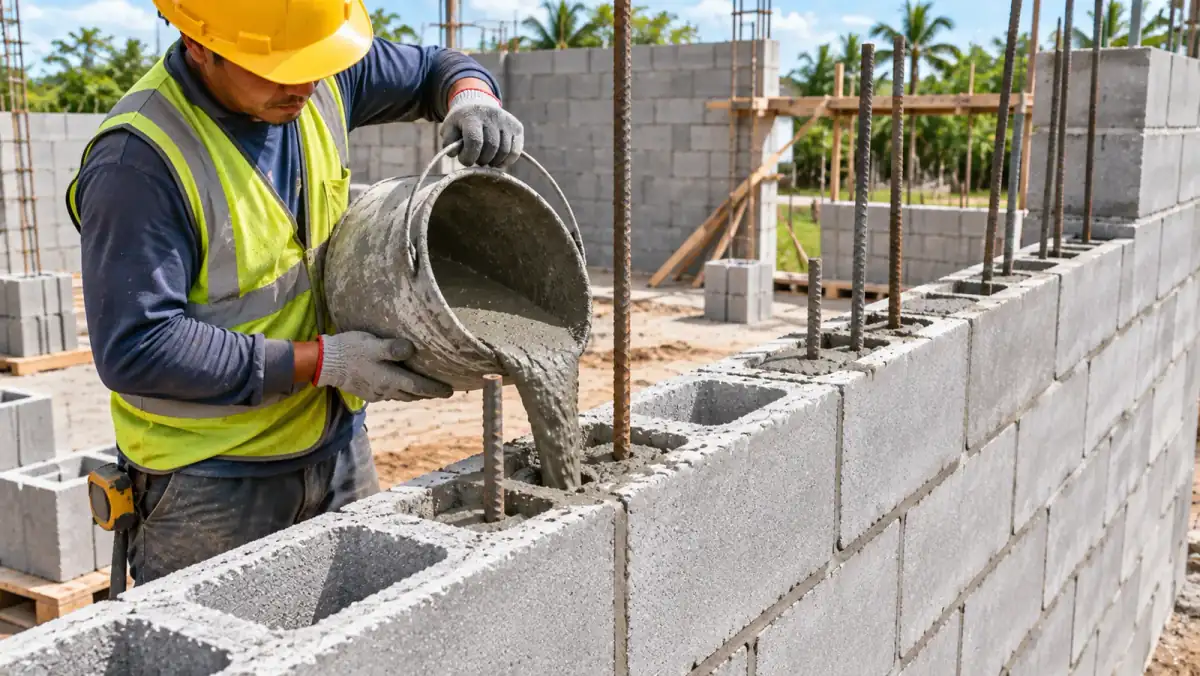
Should you fill cinder blocks with concrete?
Fill cores where the design calls for reinforcement — corners, door and window jambs, at regular spacing in seismic or wind zones, and in retaining and foundation walls. Filling every core adds weight and cost without always adding useful strength. Use a flowable grout or fine concrete, not ordinary dry mix.
For producers and developers
Turn the house count into blocks per day: 100 houses × 3,000 blocks = 300,000 blocks. Over 12 months at 25 working days per month, that is 1,000 blocks a day — within reach of a single QT4-40 or a mobile egg-laying machine. Our capacity calculator checks other models.
Machines for this application
- QT4-40 Semi-Automatic Block Making Machine — The classic low-cost block machine: 4 hollow blocks per 40-second cycle, 16.3 kW and a footprint of just 1350 × 1460 mm.
- QTM4-30A Mobile Egg-Laying Block Machine — Portable egg layer that moves on wheels and lays 4 hollow blocks per cycle directly onto a concrete floor — no pallets needed.
Turn block demand into a production plan
Send your target daily output, product sizes, local raw materials and voltage. Our engineers reply within 24 hours with a recommended configuration, layout and itemised quotation.
Frequently asked questions
How many blocks are in a square metre?
12.5 blocks of 400×200 mm face size per square metre.
How much concrete does it take to fill a cinder block?
About 0.26 cubic feet for an 8-inch hollow block — roughly 100 blocks per cubic yard — before waste.
How much waste should I allow?
Add 5–10% for cuts and breakage.