Key takeaways
- The standard US block is 8×8×16 in nominal — 7⅝×7⅝×15⅝ in actual — so that a ⅜ in mortar joint brings it to module.
- Width (thickness) is the size people mean by a “6-inch” or “12-inch” block; height and length are usually 8 and 16 inches.
- Common metric blocks are 400 mm long and 200 mm high, in 100, 150, 200 and 250 mm widths.
- Every size needs its own mould — plan your mould set around the sizes your market buys.
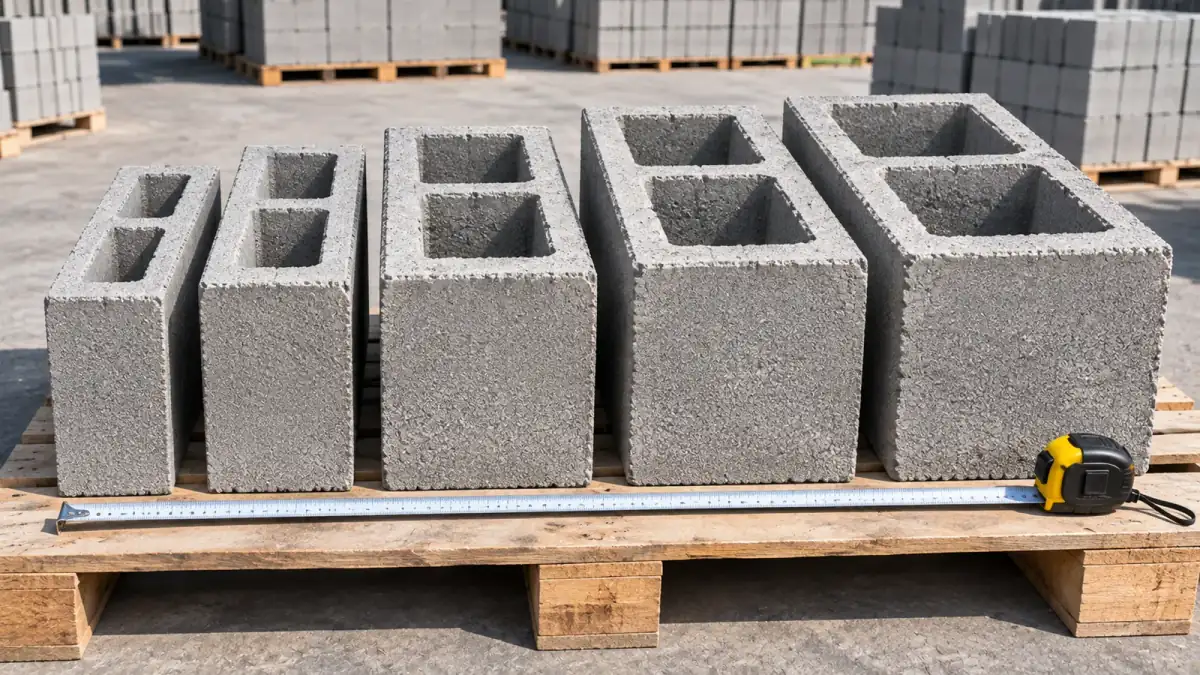
Block dimensions are given as width × height × length. Nominal sizes include a mortar joint; actual sizes are what comes off the machine. Here are the sizes you will meet in specifications, building plans and mould drawings.
Imperial (US) concrete block dimensions
| Nominal size (W×H×L) | Actual size (in) | Actual size (mm) | Typical use |
|---|---|---|---|
| 4×8×16 | 3⅝ × 7⅝ × 15⅝ | 92 × 194 × 397 | Partitions, veneer |
| 6×8×16 | 5⅝ × 7⅝ × 15⅝ | 143 × 194 × 397 | Interior and non-load-bearing walls |
| 8×8×16 | 7⅝ × 7⅝ × 15⅝ | 194 × 194 × 397 | Standard load-bearing and foundation walls |
| 10×8×16 | 9⅝ × 7⅝ × 15⅝ | 244 × 194 × 397 | Taller and heavier walls |
| 12×8×16 | 11⅝ × 7⅝ × 15⅝ | 295 × 194 × 397 | Foundations, retaining and high walls |
| 8×4×16 (half-high) | 7⅝ × 3⅝ × 15⅝ | 194 × 92 × 397 | Coursing adjustment |
| 16×16 (pier/pilaster) | 15⅝ × 7⅝ × 15⅝ | 397 × 194 × 397 | Columns, pilasters |
Metric block sizes
| Size (L×H×W, mm) | Where common | Notes |
|---|---|---|
| 400 × 200 × 200 | Africa, Middle East, Asia, Latin America | The “standard block” used to rate machines (QT4 = 4 per cycle) |
| 400 × 200 × 150 | Same | Common “6-inch” block (e.g. Nigeria, Ghana) |
| 400 × 200 × 100 | Same | Partition block |
| 390 × 190 × 190 | Several markets | Actual size of a 400×200×200 nominal block with 10 mm joints |
| 440 × 215 × 100/140/215 | UK and Ireland | Face size equals two bricks plus a joint |
| 390 × 190 × 100/150/200 | Philippines and others (CHB) | Concrete hollow block (4", 5", 6") |
How high, wide and long is a cinder block?
- Height: 7⅝ in (194 mm) for a US block; 190–215 mm in metric markets.
- Length: 15⅝ in (397 mm); 390–440 mm metric.
- Width/thickness: 3⅝ to 11⅝ in; this is the “inch size” of the block.
- Face shell thickness: roughly 1–1½ in (25–38 mm) on hollow units, depending on size and standard.
Blocks per square metre / square foot
A 400×200 mm face gives 12.5 blocks per m²; an 8×16 in face gives 1.125 blocks per ft². Use our block calculator guide for walls, openings and core fill.
What block sizes mean for a producer
A block machine's rating (e.g. QT4-40) refers to 400×200×200 mm hollow blocks per cycle; smaller units fit more per cycle. Each size needs its own mould, and moulds are wear parts. Start with the two or three sizes that make up most local demand, then add half blocks, corner and lintel units. Send us a drawing or photo of the blocks sold in your market and we will confirm cavities per cycle and daily output.
Machines for this application
- Heat-Treated Concrete Block Mould — NM400 wear-resistant moulds, carburised, nitrided and quenched for more than 80,000 cycles.
- QT4-40 Semi-Automatic Block Making Machine — The classic low-cost block machine: 4 hollow blocks per 40-second cycle, 16.3 kW and a footprint of just 1350 × 1460 mm.
- QT8-15 Hourdis & Hollow Block Machine — Heavy-duty automatic machine built for hourdis (slab infill) and hollow blocks, with a JS750 mixer and 80–90 kN vibration.
Need moulds for your local block sizes?
Send your target daily output, product sizes, local raw materials and voltage. Our engineers reply within 24 hours with a recommended configuration, layout and itemised quotation.
Frequently asked questions
What are the dimensions of a standard concrete block?
In the US, 8×8×16 inches nominal (7⅝×7⅝×15⅝ in actual). In metric markets, 400×200×200 mm (often 390×190×190 mm actual).
How thick is a concrete block?
Common widths are 4, 6, 8, 10 and 12 inches nominal (100–300 mm). Face shells of hollow units are about 25–38 mm thick.
How many blocks are in a square metre?
12.5 blocks of 400×200 mm face size per square metre of wall.
What is a 6-inch block?
A block about 6 inches (150 mm) wide — 5⅝×7⅝×15⅝ in actual in the US, or 400×200×150 mm in metric markets.
Related guides
- Types of Concrete Blocks: 15 Block Types, Their Uses and the Moulds That Make Them
- What Is a Concrete Masonry Unit (CMU)? Standards, Strength, Weight and Uses
- How Many Concrete Blocks Do I Need? Block, Mortar and Core-Fill Calculator Guide
- Concrete Block Molds: Machine Moulds, Steel Grades, Mould Life and Custom Shapes