Key takeaways
- Most concrete block types differ only in shape — they are made on the same block machine with a different mould.
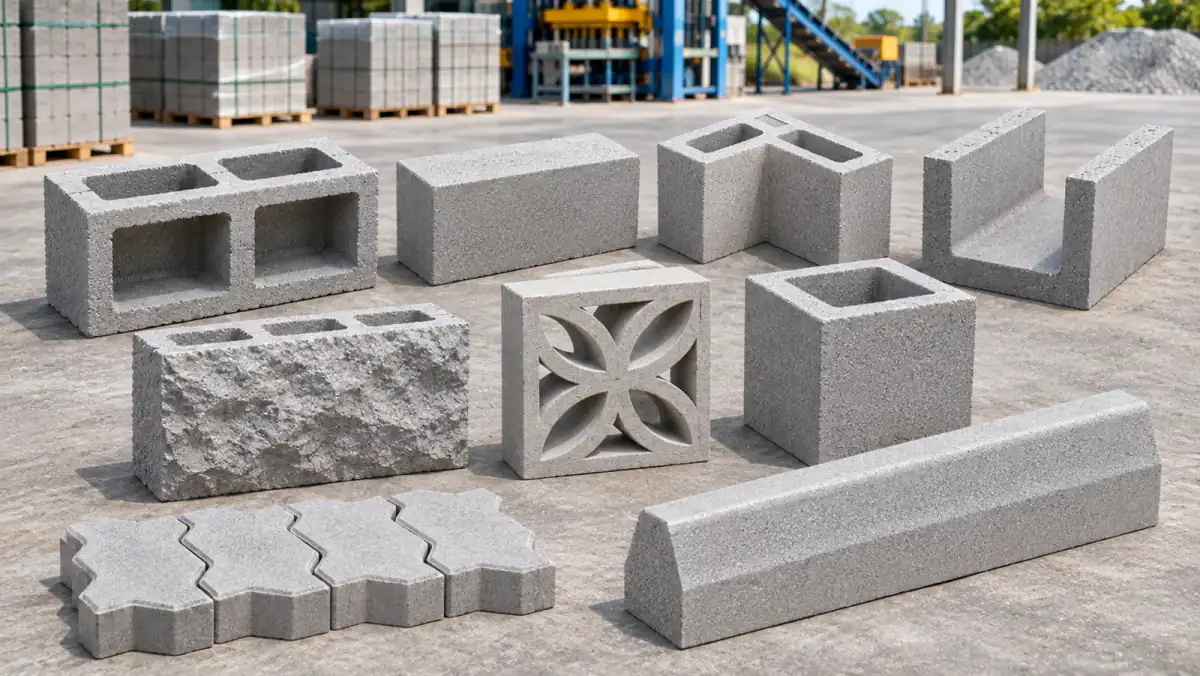
- Structural types: hollow stretcher, solid, corner, half, bond-beam, lintel, pilaster and pier blocks.
- Architectural types: split-face, ribbed, coloured, breeze/screen and capping blocks.
- Landscape and infrastructure types: pavers, curbstones, retaining-wall and grass blocks — often the most profitable.
There are dozens of concrete block shapes, but they fall into a few families. For builders, the type decides how a wall is laid and reinforced. For producers, each type is a mould — and a new revenue line from the same machine.
Structural wall blocks
| Type | What it is | Use |
|---|---|---|
| Hollow stretcher block | Standard unit with 2–3 cores | Most walls; cores can be grouted and reinforced |
| Solid block | Little or no void | Foundations, high-load and fire walls |
| Corner block | One flat, finished end | Wall corners and openings |
| Half block | Half length | Bonding and finishing courses |
| Bond-beam block | Channel for horizontal steel | Ring beams in reinforced masonry |
| Lintel (U) block | U-shaped | Over doors and windows |
| Pilaster / pier / pillar block | Large, often 16×16 in, with a central core | Columns, gate posts, piers |
| Header block | Recess for bonding to brick veneer | Composite walls |
| Hourdis (slab) block | Lightweight infill between floor joists | Ribbed slabs — see the QT8-15 |
Architectural and decorative blocks
- Split-face blocks: cast double and split to show a rough stone texture.
- Ribbed / fluted blocks: vertical ribs cast in the mould.
- Coloured blocks: pigmented with iron oxide.
- Breeze (screen) blocks: open patterns for ventilation and shade — see breeze blocks.
- Capping (coping) blocks: solid, thin units for wall tops.
Blocks by material
- Lightweight blocks with pumice, expanded clay/shale or fly ash.
- AAC blocks — autoclaved aerated concrete, cut from cakes rather than moulded.
- Foam concrete (CLC) and insulated blocks.
- Interlocking (mortarless) blocks.
Landscape and infrastructure blocks
- Interlocking pavers: rectangular, zigzag (S/unipave), I-shape, hexagon — see how pavers are made.
- Curbstones (kerbs): road edging, made on block machines with a curb mould — see curb machine guide.
- Retaining-wall blocks: segmental units with a lip or pins — see retaining walls.
- Grass (turf) pavers and round or circular blocks for planters and tree rings.
- Foundation and pier blocks: solid footing units — see foundation blocks.
For producers: one machine, many block types
All of these moulded types run on a vibro-press block machine; changing a block mould or paver mould takes roughly 20–40 minutes. Pavers, curbs and architectural blocks usually sell at a higher margin than plain hollow blocks, so a well-chosen mould set can raise profit without a new machine. Split-face blocks need a block splitter; two-layer colour pavers need a face-mix feeder (available on lines like the QT12-15).
Machines for this application
- QT8-15 Hourdis & Hollow Block Machine — Heavy-duty automatic machine built for hourdis (slab infill) and hollow blocks, with a JS750 mixer and 80–90 kN vibration.
- Heat-Treated Concrete Block Mould — NM400 wear-resistant moulds, carburised, nitrided and quenched for more than 80,000 cycles.
- Paving & Interlocking Brick Mould — Precision paver moulds with textured tamper heads for Holland, zigzag, I-shape and custom paving stones.
- QT12-15 Automatic Block & Colour Paver Machine — Large-capacity automatic plant: 12 hollow blocks every 15 seconds, 36 kW total power and a 250–300 m² workshop footprint.
Want to add new block types to your range?
Send your target daily output, product sizes, local raw materials and voltage. Our engineers reply within 24 hours with a recommended configuration, layout and itemised quotation.
Frequently asked questions
What are the main types of concrete blocks?
Hollow and solid blocks, corner, half, bond-beam, lintel and pilaster blocks for structure; split-face, coloured, breeze and capping blocks for architecture; and pavers, curbs, retaining-wall and grass blocks for landscaping.
Can one machine make different types of blocks?
Yes. A block machine changes product by changing the mould. Some types need extra equipment, such as a splitter for split-face blocks or a face-mix feeder for colour pavers.
What is a bond beam block?
A block with a channel that holds horizontal reinforcing steel and grout, forming a reinforced beam within the wall.