Key takeaways
- Foam concrete (CLC) blocks are cast from cement slurry with pre-formed foam and cured in air — low capital, but slower and less uniform than AAC.
- AAC blocks are aerated chemically and steam-cured in autoclaves — higher capital, higher and more consistent quality.
- Insulated concrete blocks combine a dense or lightweight block with EPS or other insulation inserts or fill.
- ICF (insulating concrete forms) are foam forms filled with concrete — a different system from blocks.
Energy codes are pushing builders toward walls that insulate better than plain dense block. Three block technologies compete for that demand.
Comparison
| Foam concrete (CLC) | AAC | Insulated concrete block | |
|---|---|---|---|
| How air gets in | Pre-formed foam from a foam generator | Hydrogen from aluminium reaction | Insulation insert or EPS beads |
| Curing | Air or low-pressure steam | High-pressure autoclave | Normal block curing |
| Typical density | about 400–1,200 kg/m³ | about 400–700 kg/m³ | Varies |
| Strength consistency | Moderate | High | Good (dense shell) |
| Drying shrinkage | Higher | Low | Low |
| Capital required | Low | High | Low–medium (block machine + inserts) |
Foam concrete (CLC) blocks
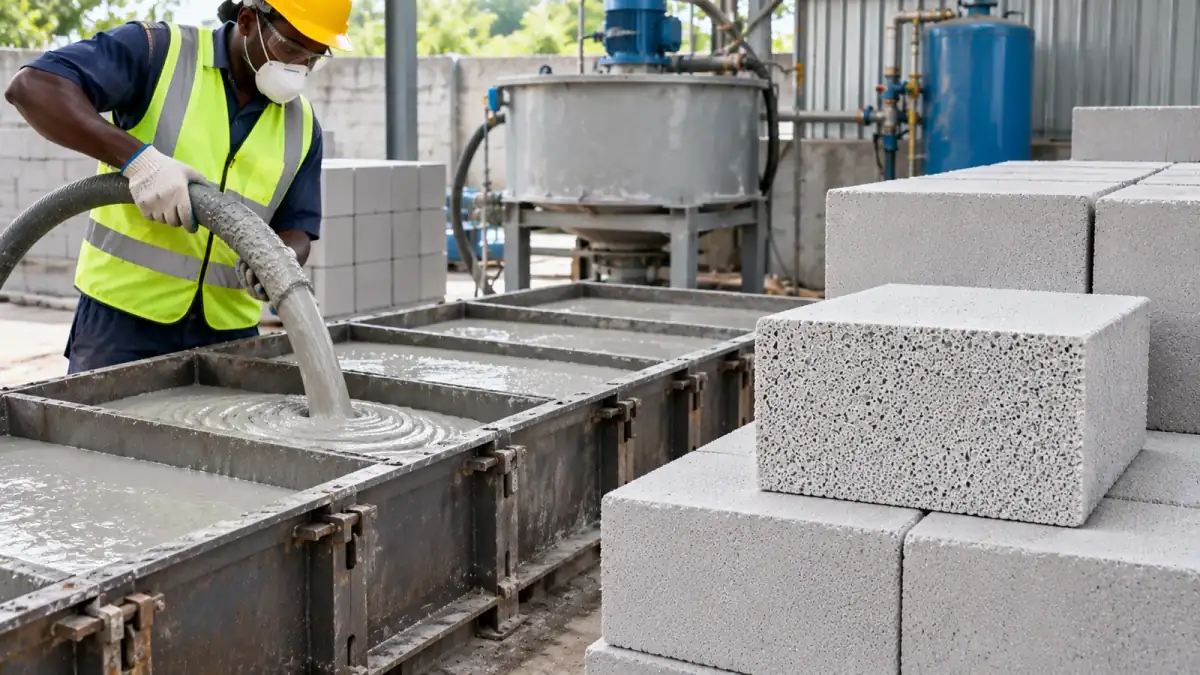
Cellular lightweight concrete is made by mixing cement, fine sand or fly ash and water into a slurry, then blending in stable foam from a foam generator. The mix is poured into moulds or large blocks that are later cut. CLC suits small producers and on-site production of insulating fill, but blocks take longer to gain strength and shrink more as they dry.
AAC blocks
AAC is the industrial route: very uniform pores, low shrinkage and high dimensional accuracy for thin-bed mortar. See what are AAC blocks and AAC plant planning.
Insulated and polystyrene concrete blocks
Two common approaches: (1) a normal hollow block with EPS inserts placed in the cores, or a block moulded around an insulation layer; (2) EPS-bead concrete blocks, very light and insulating, usually non-load-bearing. Both can be produced on a standard vibro-press block machine with a suitable mould and process.
What about ICF blocks?
ICF “blocks” are hollow foam forms stacked and filled with poured concrete. They are a formwork system, not concrete blocks — mentioned here because they are often searched together.
Which to produce?
- Small investment, local market testing: CLC or EPS concrete blocks.
- Large regional market with energy codes: AAC.
- Existing block plant: add insulated or lightweight aggregate blocks first.
Machines for this application
- AAC Block Production Line (Autoclaved Aerated Concrete) — Turnkey autoclaved aerated concrete plant from 30,000 to 300,000 m³ per year, with cutting machines from 2 m to 6 m.
- QT5-15 Automatic Concrete Block Machine Line — Best-selling mid-size automatic line: 5 hollow blocks per 15-second cycle with a 1050 × 520 mm moulding area and 100 kN vibration.
Which insulating block suits your market?
Send your target daily output, product sizes, local raw materials and voltage. Our engineers reply within 24 hours with a recommended configuration, layout and itemised quotation.
Frequently asked questions
Is foam concrete the same as AAC?
No. Both are cellular concretes, but foam concrete uses pre-formed foam and air curing, while AAC is aerated chemically and cured in high-pressure autoclaves.
Which is better, CLC or AAC blocks?
AAC is more uniform with lower shrinkage; CLC needs much less capital. The choice depends on market size and budget.
Can a normal block machine make insulated blocks?
Yes, insulated hollow blocks with inserts and EPS concrete blocks can be produced on standard block machines with suitable moulds.