Key takeaways
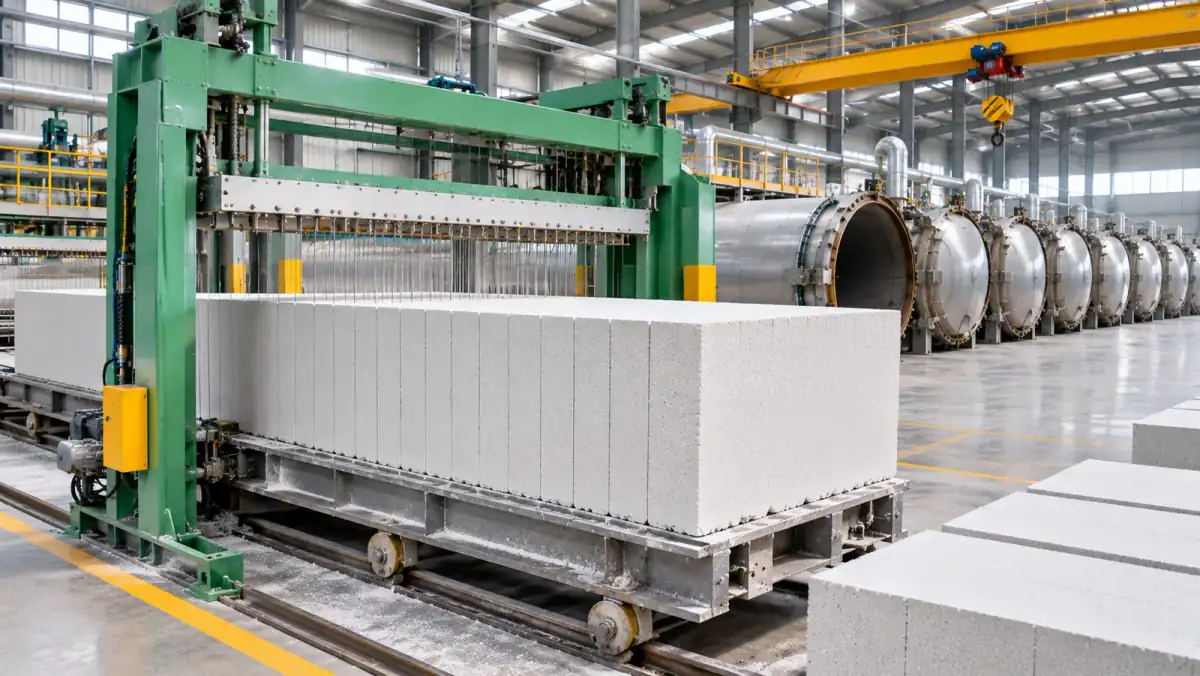
- An AAC plant has six sections: raw material preparation, dosing and pouring, pre-curing, cutting, autoclaving, and packing.
- Capacity is quoted in cubic metres per year; our lines range from about 30,000 to 300,000 m³/year with cutting machines from 2 m to 6 m.
- Autoclaves, the cutting line and the boiler are the largest equipment items.
- Secure a stable supply of lime, cement, aluminium powder and sand or fly ash before committing.
AAC block prices in a market are driven by the cost of making them — and that starts with the plant. This guide walks through an AAC block plant section by section, so you can understand quotations and plan an investment.
Plant sections and equipment
| Section | Main equipment |
|---|---|
| Raw material preparation | Ball mill for sand (or fly ash slurry tank), lime crusher and mill, silos, bucket elevators, screw conveyors |
| Dosing and pouring | Weighing scales, pouring mixer, aluminium paste mixer |
| Pre-curing | Moulds, mould carts, ferry carts, heated pre-curing room |
| Cutting | Tilting crane, horizontal and vertical cutting machines, side trimming, recycling of waste slurry |
| Autoclaving | Autoclaves (typically 2–2.68 m diameter, 21–39 m long), steam boiler, autoclave carts |
| Finished products | Separating machine, packing line, forklifts |
Choosing capacity
Capacity drives everything: number of moulds, autoclaves and the cutting machine size. Typical steps are 50,000, 100,000, 150,000, 200,000 and 300,000 m³ per year. Our AAC block production line covers this range. Size the plant to what your region can absorb — an AAC plant running at half capacity carries the same fixed costs.
Raw material check
- Sand with high silica content, or fly ash from a power station (fly ash plants avoid sand grinding).
- Quicklime with stable reactivity.
- Cement and gypsum.
- Aluminium powder or paste.
- Water and fuel for the boiler (coal, gas, biomass or oil).
Investment planning
Beyond the equipment, budget for land and buildings (an AAC plant is large), foundations for autoclaves and the cutting line, boiler house, power connection, mobile equipment, installation and commissioning, and working capital. Ask suppliers to quote by section and to specify autoclave count and dimensions, cutting accuracy and mould size, so offers are comparable.
What sets the AAC block price in your market?
Selling price is set by competition with dense blocks and bricks; production cost by energy (steam), lime and cement prices, plant utilisation and breakage. A plant near a fly ash source with a reliable fuel supply has a strong cost advantage.
Next step
Send us your target capacity, raw materials (sand or fly ash), fuel type and site size. Our engineers prepare a process flow, layout and equipment list.
Machines for this application
- AAC Block Production Line (Autoclaved Aerated Concrete) — Turnkey autoclaved aerated concrete plant from 30,000 to 300,000 m³ per year, with cutting machines from 2 m to 6 m.
- Belt & Chain Bucket Elevator — Vertical bucket elevators for sand, cement, limestone and slag — 3 to 22 kW, bulk density 0.6–2.0 t/m³.
- ZL946 Front-End Wheel Loader — Wheel loader with 1.7 m³ bucket for aggregate and raw-material handling in block plants and quarries.
Request an AAC plant layout and budget
Send your target daily output, product sizes, local raw materials and voltage. Our engineers reply within 24 hours with a recommended configuration, layout and itemised quotation.
Frequently asked questions
How much land does an AAC plant need?
It depends on capacity; even mid-size plants need several hectares for buildings, raw material storage and finished-goods yards. We confirm with a layout drawing.
Can an AAC plant use fly ash instead of sand?
Yes. Fly ash AAC plants are common near power stations and avoid sand grinding.
What capacities are available?
Our AAC lines range from about 30,000 to 300,000 m³ per year, with cutting machines from 2 m to 6 m.