Key takeaways
- Start from demand: who buys blocks locally, which sizes, at what price, and how they are delivered.
- Choose a machine you can keep busy — under-used capacity kills payback.
- Mix design, curing and consistent block height are what earn repeat contractor orders.
- Plan the site so you can add a second product (pavers, curbs) or a bigger machine later.
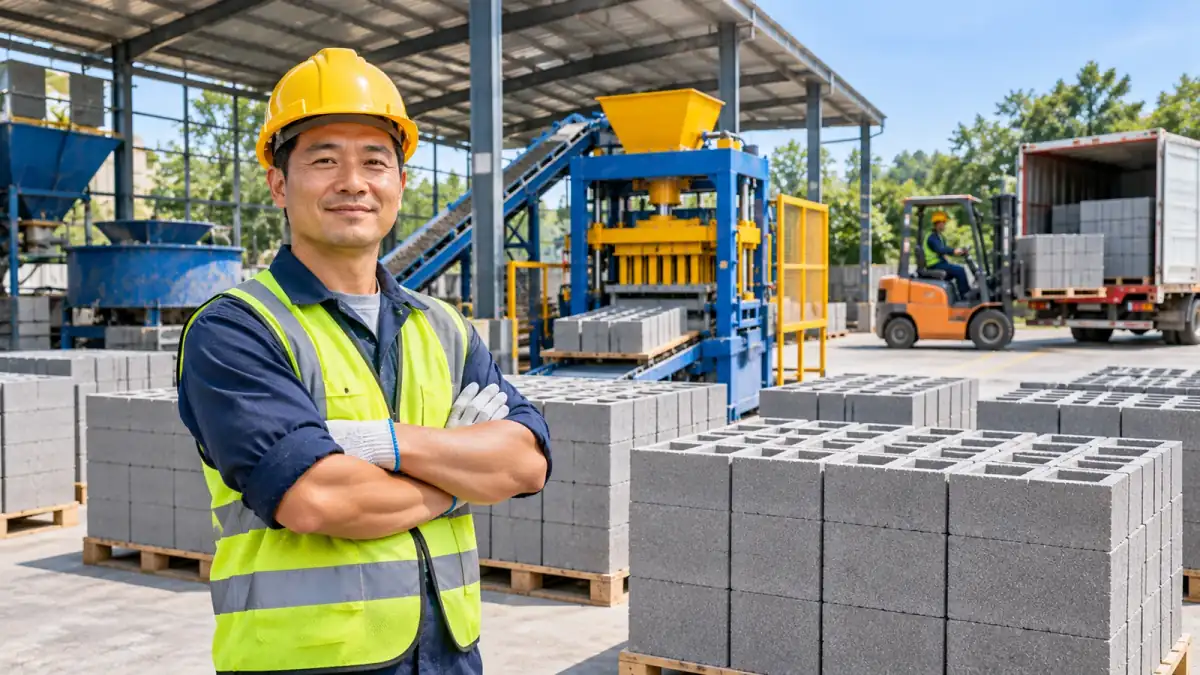
Concrete blocks are needed wherever people build, and a block yard can be started with modest capital. These ten steps reflect what separates the yards that grow from the ones that stall.
1. Research your market
Visit building sites and hardware stores. Record block sizes, prices, delivery terms and complaints (broken corners, weak blocks, late delivery). Identify big buyers: contractors, developers, government projects, merchants.
2. Choose your products
Start with the two or three sizes that sell most (often 150 and 200 mm hollow blocks), then add solid blocks, pavers and curbs. See types of concrete blocks.
3. Pick a site
Close to customers and aggregate sources, with road access for trucks, water, power (or room for a generator) and space for curing and stock — curing yards are usually several times larger than the machine shed.
4. Check regulations
Business registration, land use, environmental and water permits, and the block standard your customers must comply with.
5. Select the machine
| Daily demand | Suggested start |
|---|---|
| Under 2,000 blocks | Mobile egg-laying machine (QTM6-24) or small semi-automatic |
| 2,000–7,000 | Semi-automatic (QT4-23A) |
| 7,000–15,000 | Automatic (QT5-15) |
| 15,000+ with pavers | Automatic with face mix (QT12-15) |
Price logic: block machine price guide.
6. Secure raw materials
Agree supply of cement, sand and 0–10 mm stone; test aggregates; consider fly ash. Get a mix design — see the mix ratio guide.
7. Budget and finance
Use our cost and profit method to estimate cost per block, margin and payback with local prices. Include pallets, moulds, working capital and transport.
8. Hire and train
A semi-automatic plant runs with roughly 4–6 workers per shift; automatic lines similar, with more output per person. Train on mixing, machine operation, curing and maintenance.
9. Control quality
Weigh batches, keep water consistent, cure properly (curing guide), test strength regularly and keep records — engineers and tender boards ask for them.
10. Sell and scale
Offer delivery, keep stock, and build relationships with contractors and merchants. Reinvest in a second product (pavers, curbs) or a larger machine as demand grows.
Machines for this application
- QT4-23A Semi-Automatic Hydraulic Block Machine — Hydraulic-assisted semi-automatic machine with a 24-second cycle — up to 6,720 blocks a day in a 60 m² workshop.
- QTM6-24 Hydraulic Movable Block Machine — Hydraulic egg-laying machine with operator cab and sun canopy: 6 hollow blocks every 20–30 seconds.
- QT5-15 Automatic Concrete Block Machine Line — Best-selling mid-size automatic line: 5 hollow blocks per 15-second cycle with a 1050 × 520 mm moulding area and 100 kN vibration.
- QT12-15 Automatic Block & Colour Paver Machine — Large-capacity automatic plant: 12 hollow blocks every 15 seconds, 36 kW total power and a 250–300 m² workshop footprint.
Get a feasibility plan for your block business
Send your target daily output, product sizes, local raw materials and voltage. Our engineers reply within 24 hours with a recommended configuration, layout and itemised quotation.
Frequently asked questions
Is a block making business profitable?
It can be when sales volume is steady, cement use is optimised and breakage is low. Calculate with local prices using a cost-per-block method.
How many workers does a block plant need?
Typically 4–6 per shift for semi-automatic or automatic machines, plus drivers and sales staff.
What is the best machine to start a block business?
For most start-ups, a semi-automatic QT4 machine or a mobile egg-laying machine; larger markets justify an automatic line.