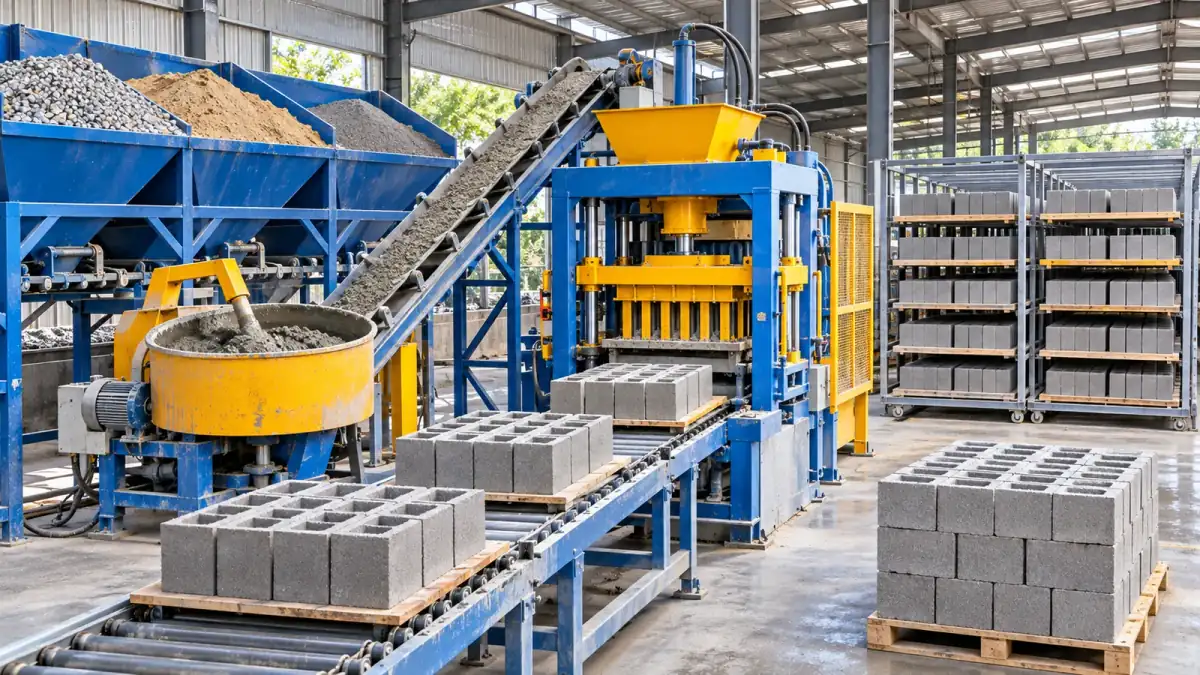
Key takeaways
- Concrete blocks are made from a zero-slump (earth-moist) mix of cement, sand, aggregate and water, compacted in a steel mould by vibration and pressure.
- The six stages are: raw material preparation, batching, mixing, moulding, curing and stacking/storage.
- Blocks can be demoulded within seconds because the dry mix holds its shape; strength develops during curing over days.
- Mix quality and curing decide strength as much as the machine does.
A concrete block looks simple, but the way it is made determines whether it reaches 3.5 MPa or 10 MPa, whether its corners survive delivery and whether your yard earns money. Here is the concrete block production process as it runs in a modern block plant — the same sequence applies to cement blocks, “cinder” blocks, solid bricks and pavers.
1. Raw materials
- Cement: ordinary Portland cement is standard; blended cements also work.
- Fine aggregate: clean sand, 0–4 mm, low in clay and silt.
- Coarse aggregate: crushed stone or gravel up to about 10 mm (smaller for thin-walled blocks).
- Supplementary materials: fly ash, slag, stone dust or crushed concrete can replace part of the cement or aggregate — see fly ash bricks.
- Water: just enough for an earth-moist mix (water-cement ratio typically 0.35–0.45).
2. Batching
Aggregates are weighed in a batching machine with two to four bins; cement is fed from a silo by screw conveyor and weighed separately. Weight batching is more accurate than volume batching, because sand moisture changes its volume. Start-up yards often batch by volume with gauge boxes and move to weight batching as volume grows.
3. Mixing
A forced-action mixer (pan or twin-shaft, e.g. JS500/JS750) blends the dry materials, then water is added until the mix is earth-moist: squeezed in the hand, it holds shape without dripping. Our mix ratio guide lists starting recipes.
4. Moulding: vibration and pressure
This is the block machine's job:
- A pallet slides under the mould.
- The feeder box fills the mould cavities with mix.
- Table vibration (on larger machines 80–100 kN) fluidises and compacts the mix.
- The tamper head presses down — by hydraulic force on modern machines — while vibration continues, forming the block to exact height.
- The mould lifts, leaving green blocks standing on the pallet; the pallet moves out on the conveyor.
On a fully automatic line such as the QT5-15 the full cycle takes about 15 seconds. The steel block mould defines the block size and shape, which is why the same machine makes hollow blocks, solid bricks, pavers and curbs.
5. Curing
Green blocks have only enough strength to stand. They are moved to a shaded curing area or a curing chamber and kept moist for at least 7 days. High-output plants use steam curing at 60–70 °C to reach handling strength in 12–24 hours. Details: how to cure concrete blocks.
6. Stacking, storage and quality control
After initial curing, blocks are de-palleted, stacked into cubes (by hand or with a stacker), and stored until they reach delivery strength. Good plants test samples for dimensions, density and compressive strength at 7 and 28 days against the standard their customers specify (e.g. ASTM C90, EN 771-3 or a national standard).
Can you make concrete blocks by hand?
Yes — DIY concrete blocks can be cast in wooden or steel forms with a wetter mix and left to set for a day before demoulding. Hand-made blocks are slow (one mould, one block per day) and less dense than machine-vibrated blocks. They suit garden projects, not commercial supply. For a business, even the smallest machine multiplies output and quality.
Are cinder blocks made the same way?
Historically, cinder blocks used coal cinders as aggregate. Today almost all “cinder blocks” are concrete masonry units made exactly as described above. See cinder block vs concrete block.
Machines for this application
- QT5-15 Automatic Concrete Block Machine Line — Best-selling mid-size automatic line: 5 hollow blocks per 15-second cycle with a 1050 × 520 mm moulding area and 100 kN vibration.
- QT4-23A Semi-Automatic Hydraulic Block Machine — Hydraulic-assisted semi-automatic machine with a 24-second cycle — up to 6,720 blocks a day in a 60 m² workshop.
- Heat-Treated Concrete Block Mould — NM400 wear-resistant moulds, carburised, nitrided and quenched for more than 80,000 cycles.
Planning a concrete block production line?
Send your target daily output, product sizes, local raw materials and voltage. Our engineers reply within 24 hours with a recommended configuration, layout and itemised quotation.
Frequently asked questions
How long does it take to make a concrete block?
A machine forms a block in 15–40 seconds depending on the model, but the block needs about 7 days of moist curing for handling strength and 28 days to reach design strength (or 12–24 hours with steam curing).
What is the ratio for making concrete blocks?
A common starting point for hollow blocks is 1 part cement to 6–8 parts aggregates by volume with an earth-moist consistency. Confirm with compressive tests.
Why are concrete blocks vibrated?
Vibration lets the dry mix flow into every corner of the mould and expels air, producing dense blocks with sharp edges and higher strength.