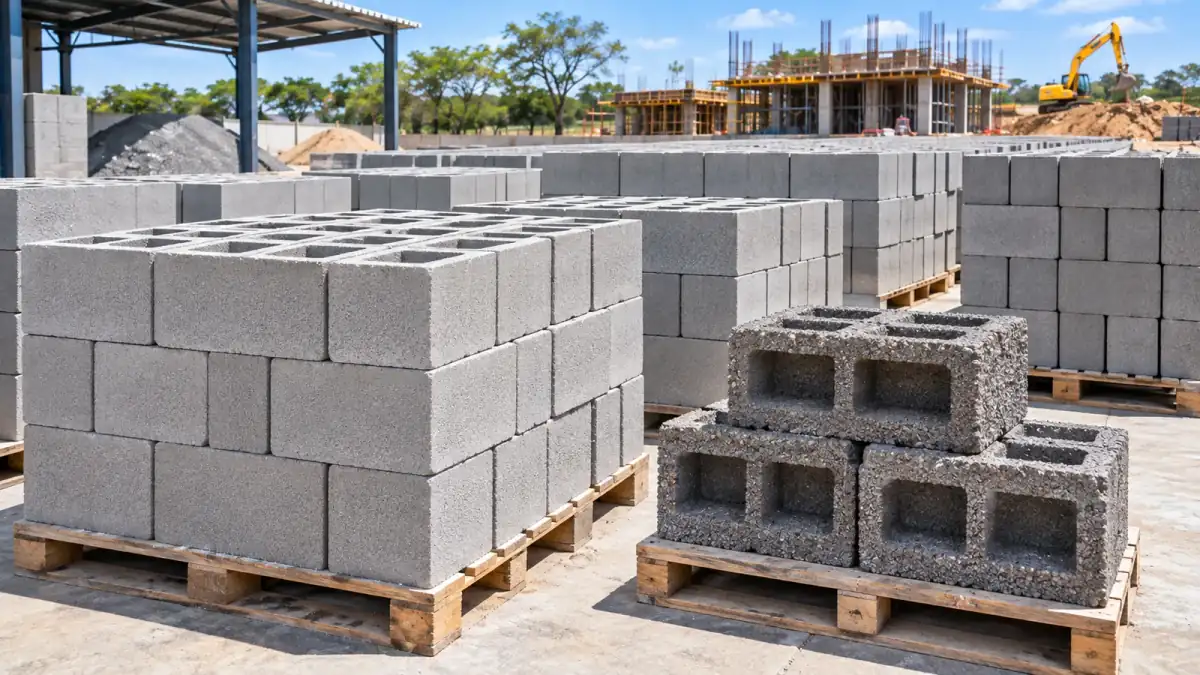
Key takeaways
- A true cinder block uses coal cinders (furnace ash) as aggregate; a concrete block uses sand and crushed stone or gravel.
- Most blocks sold as “cinder blocks” today are concrete masonry units (CMU) — the name stuck after the material changed.
- Concrete blocks are heavier and stronger; cinder-aggregate blocks were lighter but weaker and less durable.
- Modern lightweight blocks use expanded clay, shale, pumice or fly ash instead of cinders.
“Cinder block” and “concrete block” are used interchangeably by homeowners, contractors and even suppliers. Technically they are different products, and the difference matters if you are specifying a load-bearing wall or planning to produce blocks.
Definitions
A concrete block is a precast unit made from Portland cement, sand, crushed stone or gravel and water, compacted by vibration and pressure in a block machine. Standards bodies call it a concrete masonry unit (CMU).
A cinder block is a block in which the coarse aggregate is coal cinders — the clinker and ash left by burning coal in boilers and furnaces. It is still bound with cement.
Cinder block vs concrete block at a glance
| Cinder block | Concrete block (CMU) | |
|---|---|---|
| Aggregate | Coal cinders / furnace ash | Sand, crushed stone, gravel (or lightweight aggregate) |
| Weight (8×8×16 in hollow) | Lighter | About 16–17 kg (35–38 lb) normal weight |
| Compressive strength | Lower | Load-bearing units typically meet ASTM C90 (min. 2,000 psi / 13.8 MPa net area) |
| Durability | More porous, can corrode embedded steel | Dense, durable, accepted by building codes |
| Availability today | Rare | Standard product everywhere |
Why are they called cinder blocks?
When hollow concrete blocks spread in the early twentieth century, coal cinders were a cheap, abundant by-product from power stations, factories and railways. Blocks made with them were lighter to carry and lay, and the name “cinder block” became the everyday word for any grey masonry block. As coal ash disappeared from cities and building codes demanded consistent strength, producers switched to sand and stone — but the name stayed.
When were cinder blocks invented?
Hollow concrete block making became practical around 1900, when a cast-iron block machine with removable cores was patented in the United States. Within two decades thousands of small producers were making blocks, and cinder-aggregate blocks followed in the 1910s–1920s. Today's vibro-press machines are the direct descendants of those early moulds — with hydraulics, PLC control and outputs of thousands of blocks per hour.
Which should you use?
For foundations, load-bearing walls and anything a building inspector will check, use concrete blocks that meet the local standard. If weight matters (upper storeys, long transport), specify lightweight concrete blocks made with expanded shale, pumice or fly ash rather than true cinders.
Producing concrete blocks
Because “cinder blocks” are concrete blocks, they are made on the same machines: a semi-automatic machine such as the QT4-40 for a start-up yard, or an automatic line such as the QT10-15, which is designed to use fly ash — the modern, controlled successor to coal cinders — to save cement. How they are made: the block production process.
Machines for this application
- QT4-40 Semi-Automatic Block Making Machine — The classic low-cost block machine: 4 hollow blocks per 40-second cycle, 16.3 kW and a footprint of just 1350 × 1460 mm.
- QT10-15 Fully Automatic Block Production Line — High-output automatic line producing 10 hollow blocks per cycle, designed to use fly ash and industrial by-products to lower raw-material cost.
Want to produce concrete blocks for your local market?
Send your target daily output, product sizes, local raw materials and voltage. Our engineers reply within 24 hours with a recommended configuration, layout and itemised quotation.
Frequently asked questions
Are cinder blocks and concrete blocks the same?
Not technically. Cinder blocks use coal cinders as aggregate; concrete blocks use sand and stone. But most blocks sold as cinder blocks today are actually concrete blocks.
Which is stronger, cinder block or concrete block?
Concrete block. Normal-weight concrete masonry units are denser and are made to meet compressive strength standards such as ASTM C90.
How much does one cinder block weigh?
A standard 8×8×16 inch hollow concrete block weighs roughly 16–17 kg (35–38 lb); lightweight versions weigh less.
Are cinder blocks still made?
True coal-cinder blocks are rare. The term now usually refers to ordinary concrete blocks.