Key takeaways
- Lightweight blocks replace some or all normal aggregate with porous aggregates (pumice, expanded clay/shale, perlite, EPS) or with air (AAC, foam concrete).
- Moulded lightweight aggregate blocks run on ordinary vibro-press block machines; AAC and foam concrete need different processes.
- Lower weight means faster laying, lower transport cost and better insulation — but usually lower strength per unit.
- Lightweight aggregate availability and price decide whether lightweight blocks are profitable in your market.
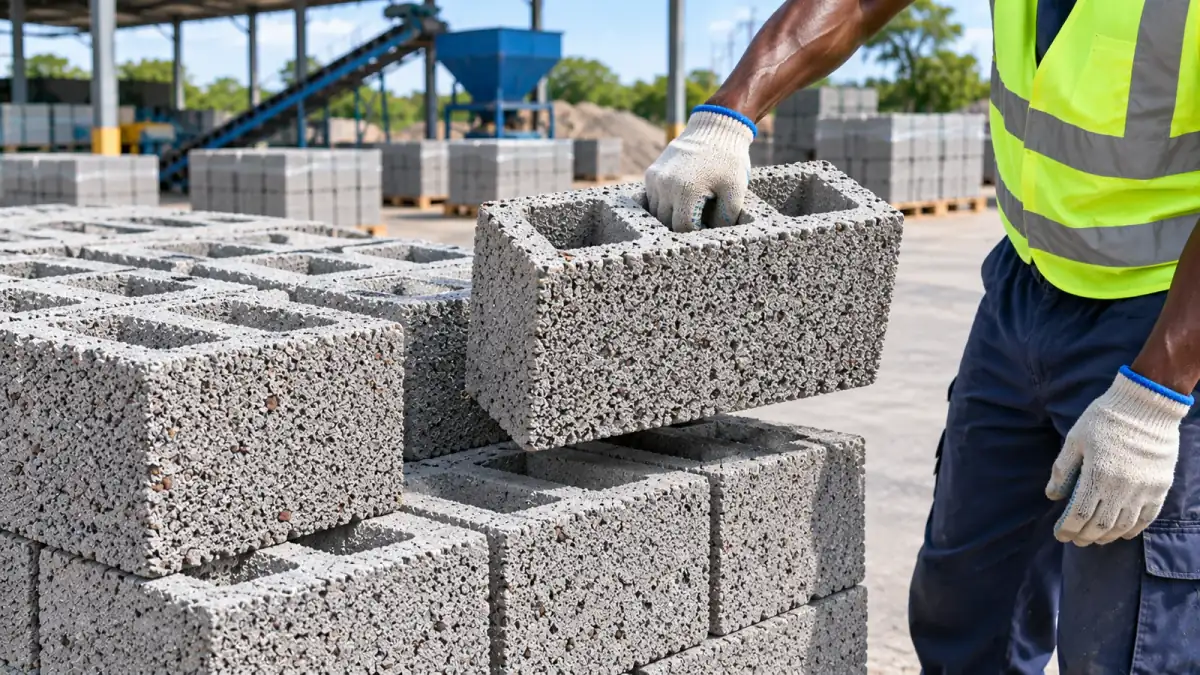
A normal-weight 8-inch hollow block weighs around 16–17 kg. Cut that by a quarter or more and masons lay faster, trucks carry more and walls insulate better. That is the case for lightweight concrete blocks — and for producers, the question is which lightweight technology suits the local materials.
Three routes to a lighter block
| Route | How weight is reduced | Typical density | Production |
|---|---|---|---|
| Lightweight aggregate blocks | Porous aggregate (pumice, expanded clay or shale, perlite, scoria, sintered fly ash, EPS beads) | roughly 1,000–1,700 kg/m³ (concrete) | Standard vibro-press block machine |
| Autoclaved aerated concrete (AAC) | Gas bubbles from aluminium powder, then autoclaving | about 400–700 kg/m³ | Dedicated AAC plant |
| Foam concrete (CLC) | Pre-formed foam mixed into cement slurry | about 400–1,200 kg/m³ | Foam generator, moulds, air curing |
Lightweight aggregates compared
- Pumice and scoria: natural volcanic aggregates; excellent where locally quarried (East Africa, parts of Latin America and Asia).
- Expanded clay (LECA) and expanded shale: manufactured in rotary kilns; uniform and strong, widely used for lightweight CMU in North America and Europe.
- Perlite: very light expanded volcanic glass; perlite blocks are good insulators but need careful mix design for strength.
- EPS beads: polystyrene concrete blocks are very light and insulating, used mainly for non-load-bearing walls.
- Sintered or pelletised fly ash: a by-product route where power stations are nearby.
Lightweight concrete mix for blocks
A lightweight block mix stays earth-moist like any block mix. Start from a normal recipe (see the mix ratio guide) and replace coarse aggregate by volume with lightweight aggregate. Pre-wet porous aggregates so they do not absorb mixing water, and expect to raise cement content slightly to keep strength. Test density and compressive strength at 7 and 28 days before production.
Lightweight CMU classes
ASTM C90 classifies lightweight CMU as units with oven-dry density below 105 lb/ft³ (about 1,680 kg/m³). A lightweight 8×8×16 in block typically weighs around 11–13 kg. More: CMU guide.
Pros and cons
Advantages: lighter to handle, faster laying, lower dead load on structures, better thermal insulation and fire resistance, lower freight cost per wall area.
Limitations: lower unit strength than normal-weight blocks, higher water absorption, aggregate cost can be higher, and some markets prefer the familiar heavy block.
Producing lightweight blocks
Lightweight aggregate blocks run on the same machines as standard blocks: a fully automatic line such as the QT10-15 or QT5-15 with a strong vibration system compacts porous mixes well. If your goal is very low density (below about 700 kg/m³) and large wall units, consider an AAC block plant instead — compare in foam concrete vs AAC.
Machines for this application
- QT10-15 Fully Automatic Block Production Line — High-output automatic line producing 10 hollow blocks per cycle, designed to use fly ash and industrial by-products to lower raw-material cost.
- AAC Block Production Line (Autoclaved Aerated Concrete) — Turnkey autoclaved aerated concrete plant from 30,000 to 300,000 m³ per year, with cutting machines from 2 m to 6 m.
- QT5-15 Automatic Concrete Block Machine Line — Best-selling mid-size automatic line: 5 hollow blocks per 15-second cycle with a 1050 × 520 mm moulding area and 100 kN vibration.
Want to produce lightweight blocks with local materials?
Send your target daily output, product sizes, local raw materials and voltage. Our engineers reply within 24 hours with a recommended configuration, layout and itemised quotation.
Frequently asked questions
What are lightweight concrete blocks made of?
Cement plus porous aggregates such as pumice, expanded clay or shale, perlite, scoria, fly ash or EPS beads; or aerated concrete (AAC) and foam concrete.
How much does a lightweight concrete block weigh?
A lightweight 8×8×16 inch hollow block typically weighs about 11–13 kg (25–29 lb), versus 16–17 kg for normal weight.
Are lightweight blocks strong enough for load-bearing walls?
Many lightweight CMU meet load-bearing standards such as ASTM C90. Very low-density blocks are usually for non-load-bearing or low-rise use.
Can a normal block machine make lightweight blocks?
Yes, for lightweight aggregate blocks. AAC and foam concrete need different equipment.