Key takeaways
- A concrete masonry unit (CMU) is a machine-made block of cement, aggregate and water used to build masonry walls.
- In the US, load-bearing CMU are specified to ASTM C90; in Europe to EN 771-3; many countries have equivalents.
- CMU are classed by density: lightweight, medium-weight and normal-weight.
- Meeting the standard is mostly about mix design, compaction and curing — which is where the block machine matters.
“Concrete masonry unit” — CMU — is the technical name for what most people call a concrete block, cement block or cinder block. Architects and engineers use the term because it is defined by standards that set dimensions, strength, absorption and density.
CMU definition
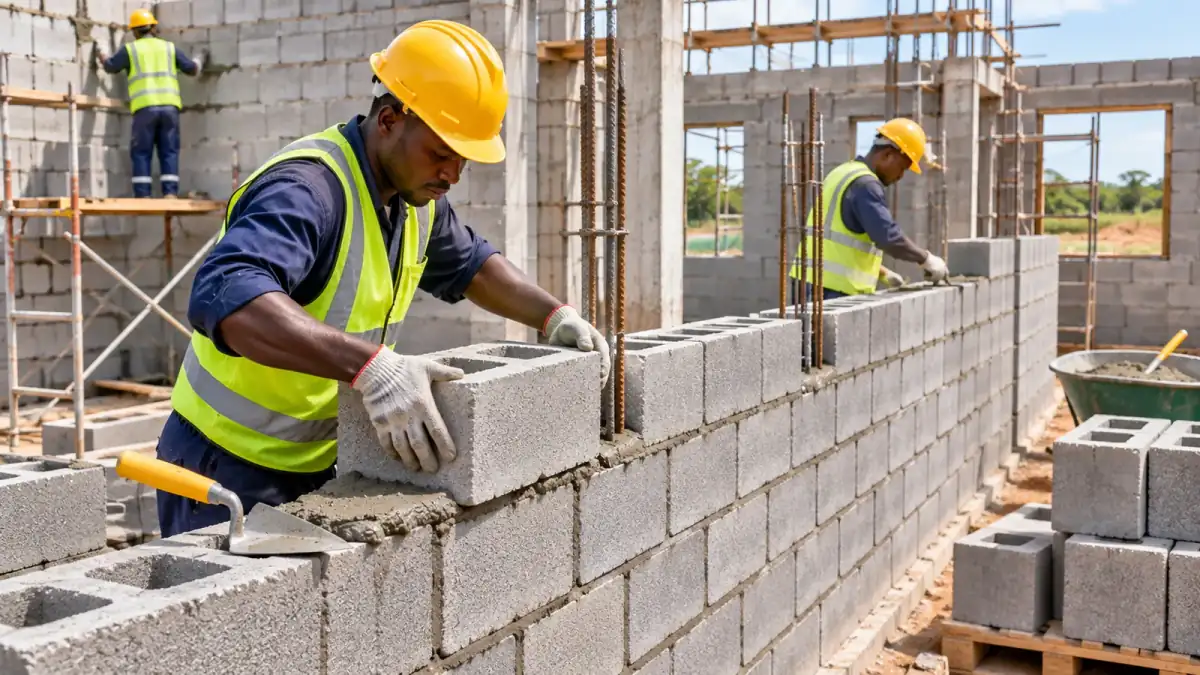
A CMU is a precast masonry unit made from Portland cement (and sometimes supplementary materials like fly ash or slag), water and aggregates, formed in a block machine by vibration and compaction and then cured. CMU can be hollow (with cores) or solid, and come in standard and architectural finishes.
Key standards
| Standard | Region | Covers |
|---|---|---|
| ASTM C90 | USA and many export markets | Load-bearing concrete masonry units |
| ASTM C129 | USA | Non-load-bearing units |
| ASTM C55 | USA | Concrete building brick |
| EN 771-3 | Europe | Aggregate concrete masonry units |
| National standards | e.g. India, Nigeria, Kenya, South Africa, Philippines | Dimensions and strength classes for local blocks |
Under ASTM C90, the average net-area compressive strength of three units must be at least 2,000 psi (13.8 MPa). Other standards define strength classes; always check what your customers specify.
Density classes and weight
| Class (ASTM C90) | Oven-dry density | Approx. weight, 8×8×16 in hollow |
|---|---|---|
| Lightweight | < 105 lb/ft³ (1,680 kg/m³) | about 11–13 kg (25–29 lb) |
| Medium weight | 105–125 lb/ft³ | about 13–15 kg (29–33 lb) |
| Normal weight | ≥ 125 lb/ft³ (2,000 kg/m³) | about 16–17 kg (35–38 lb) |
Weights vary with core design and aggregate; treat these as typical values.
Where CMU are used
- Foundation and basement walls
- Load-bearing walls in houses, schools and warehouses
- Reinforced and grouted shear walls
- Fire walls and partition walls
- Retaining walls, fences and site walls
Sizes
The US module is 8×8×16 inches nominal (7⅝×7⅝×15⅝ in actual), allowing a ⅜-inch mortar joint. Metric markets commonly use 400×200×200, 400×200×150 and 400×200×100 mm, or 440×215 mm faces in the UK. Full charts: concrete block sizes and dimensions.
Producing CMU to standard
To pass strength and absorption tests consistently, a plant needs accurate weight batching, a forced-action mixer, strong vibration with hydraulic pressing, precise moulds and controlled curing. Automatic lines such as the QT5-15 and QT12-15 deliver repeatable block height and density cycle after cycle. Our engineers provide a mix design for your local aggregates as part of each project.
Machines for this application
- QT5-15 Automatic Concrete Block Machine Line — Best-selling mid-size automatic line: 5 hollow blocks per 15-second cycle with a 1050 × 520 mm moulding area and 100 kN vibration.
- QT12-15 Automatic Block & Colour Paver Machine — Large-capacity automatic plant: 12 hollow blocks every 15 seconds, 36 kW total power and a 250–300 m² workshop footprint.
- QT4-15 Automatic Hydraulic Block Making Machine — Entry-level fully automatic block machine with PLC control and hydraulic pressing — the lowest-cost way to move from manual to automatic production.
Need CMU blocks that pass ASTM or EN testing?
Send your target daily output, product sizes, local raw materials and voltage. Our engineers reply within 24 hours with a recommended configuration, layout and itemised quotation.
Frequently asked questions
What does CMU stand for?
Concrete masonry unit — the technical term for a concrete block.
How much does a CMU block weigh?
A normal-weight 8×8×16 inch hollow CMU weighs about 16–17 kg (35–38 lb); lightweight units weigh about 11–13 kg.
What strength must a CMU have?
Load-bearing units to ASTM C90 must average at least 2,000 psi (13.8 MPa) on the net area. Other standards set their own classes.
Is CMU the same as cinder block?
In everyday language yes; technically cinder blocks used coal cinders as aggregate, while CMU use sand and stone or engineered lightweight aggregates.