Key takeaways
- Fly ash bricks are made from fly ash, sand or stone dust, a binder (lime or cement) and often gypsum, pressed and cured — not fired.
- A typical starting mix is roughly 50–60% fly ash, 25–35% sand or stone dust, 8–12% binder and a few percent gypsum.
- They are lighter and more uniform than burnt clay bricks and reuse an industrial by-product.
- Any strong vibro-press or hydraulic brick machine can make them with a brick mould.
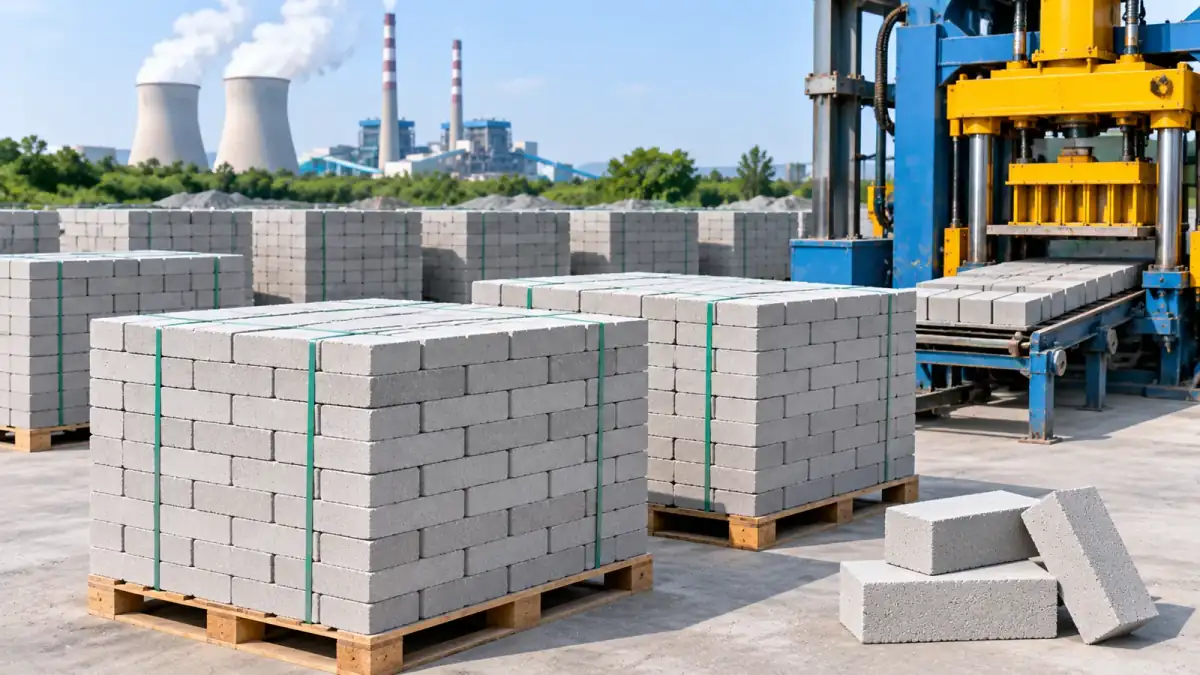
Coal power stations produce enormous volumes of fly ash. Turning it into bricks saves topsoil, avoids kiln fuel and gives brick makers a cheap raw material. Fly ash bricks are now a mainstream product in India and are spreading wherever fly ash is available.
Composition
| Ingredient | Typical share by weight | Role |
|---|---|---|
| Fly ash (Class F or C) | 50–60% | Main pozzolanic material |
| Sand or stone dust | 25–35% | Aggregate skeleton |
| Lime or cement | 8–12% | Binder |
| Gypsum | 2–5% | Accelerates early strength |
| Water | As needed for a semi-dry mix |
These are starting points; test with your fly ash and confirm strength at 14 and 28 days. In India, fly ash lime bricks are covered by IS 12894.
Properties
- Common size in India: 230 × 110 × 75 mm (modular 190 × 90 × 90 mm also used).
- Compressive strength typically 7.5–10 MPa or more with good compaction and curing.
- Uniform shape and sharp edges — less plaster needed.
- Lower water absorption than many hand-made clay bricks.
Advantages over burnt clay bricks
- No firing — no kiln fuel and lower emissions.
- Uses an industrial waste instead of fertile topsoil.
- Consistent dimensions and strength.
- Production all year round, not seasonal.
Production process
- Weigh fly ash, sand/stone dust, lime or cement and gypsum.
- Mix in a pan mixer with controlled water.
- Press in a vibro-press or hydraulic brick machine.
- Air-dry 1–2 days, then water-cure 14+ days (or steam cure).
Fly ash brick making machines
A fly ash brick machine is a block machine with a brick mould. Strong vibration plus hydraulic pressing matters because fine fly ash mixes are harder to compact. Our QT10-15 fly ash block production line is designed for fly ash and industrial by-products; smaller producers start with the QT4-15. The same line makes fly ash hollow blocks and pavers. See also the mix ratio guide for cement replacement in concrete blocks.
Machines for this application
- QT10-15 Fully Automatic Block Production Line — High-output automatic line producing 10 hollow blocks per cycle, designed to use fly ash and industrial by-products to lower raw-material cost.
- QT4-15 Automatic Hydraulic Block Making Machine — Entry-level fully automatic block machine with PLC control and hydraulic pressing — the lowest-cost way to move from manual to automatic production.
- QT12-15 Automatic Block & Colour Paver Machine — Large-capacity automatic plant: 12 hollow blocks every 15 seconds, 36 kW total power and a 250–300 m² workshop footprint.
Have access to fly ash? Get a plant proposal.
Send your target daily output, product sizes, local raw materials and voltage. Our engineers reply within 24 hours with a recommended configuration, layout and itemised quotation.
Frequently asked questions
What are fly ash bricks made of?
Fly ash, sand or stone dust, lime or cement and usually a small amount of gypsum, pressed and water- or steam-cured.
Are fly ash bricks better than clay bricks?
They are more uniform, need no firing and reuse waste; with good production they meet or exceed common clay brick strengths.
Which machine makes fly ash bricks?
A vibro-press or hydraulic brick machine fitted with a brick mould, such as our QT10-15 line.
Related guides
- Concrete Block Mix Ratio: Proven Recipes for Hollow Blocks, Solid Bricks and Pavers
- Concrete Bricks vs Clay Bricks: Cost, Strength, Durability and Production
- How Are Concrete Blocks Made? The Block Production Process Step by Step
- Block Making Machine Price: What Drives the Cost of a Block or Brick Machine