Key takeaways
- Compressed earth blocks are made by pressing damp, sieved soil — usually stabilised with 5–10% cement or lime — in a mechanical or hydraulic press.
- Good CEB soil contains roughly 15–30% clay plus silt, with the rest sand.
- Stabilised CEB typically reach 3–7 MPa — enough for one- and two-storey buildings when designed correctly.
- Because there is no firing, CEB have very low embodied energy compared with burnt bricks.
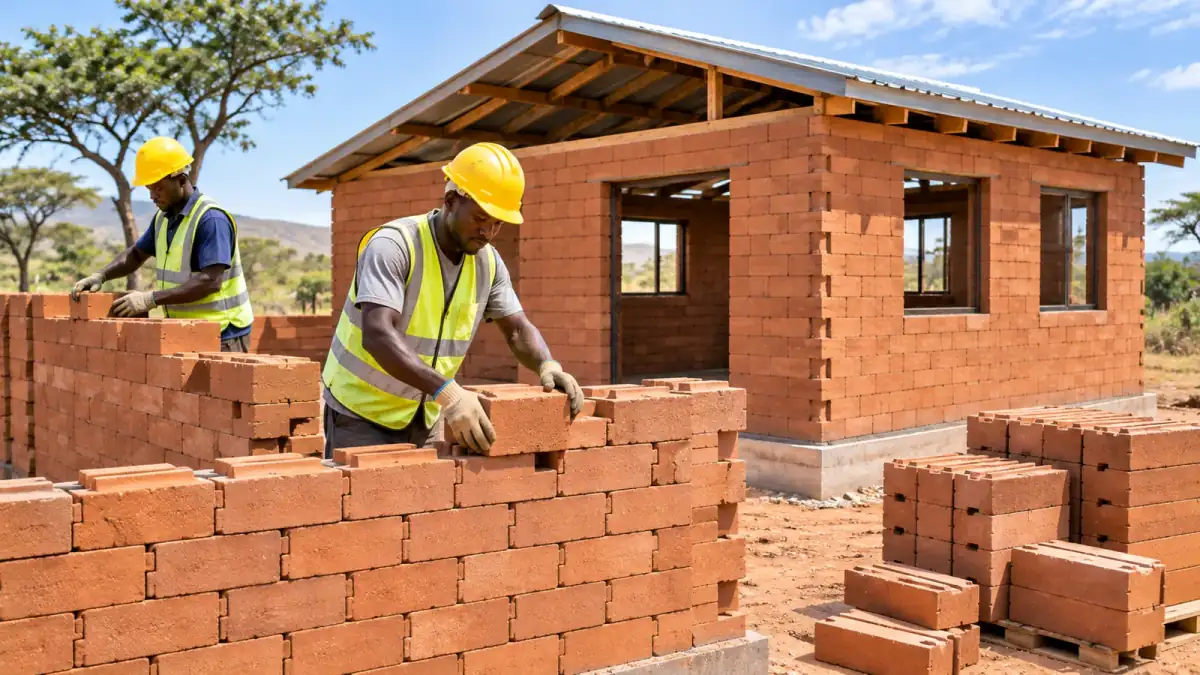
Earth is the oldest building material, and compressed earth blocks (CEB) are its modern, engineered form. A press turns local soil into dense, regular blocks that can be laid like bricks — or, in interlocking designs, dry-stacked with minimal mortar.
What is a compressed earth block?
A CEB is soil compacted in a steel mould under high pressure. Unlike adobe, which is wet and sun-dried, CEB are pressed damp, so they are denser and dimensionally accurate. Most modern CEB are stabilised with a small proportion of cement or lime to improve water resistance and strength.
Which soil works?
- Clay content roughly 15–30% with silt; the rest sand. Laterite soils are often ideal.
- No topsoil or organic matter.
- Sieve to remove stones above about 5 mm; crush clods with a soil crusher.
- Quick field checks: jar sedimentation test and a hand “ribbon” test; then laboratory testing before production.
Stabilisation
| Stabiliser | Typical dosage | Best for |
|---|---|---|
| Cement | 5–10% | Sandy soils |
| Lime | 6–12% | Clay-rich soils |
| None | — | Dry climates, protected walls only |
Strength and durability
Well-made stabilised CEB typically achieve 3–7 MPa dry compressive strength. Durability depends on stabiliser content, compaction pressure and curing (keep blocks damp and covered for 7–14 days). Standards and guidance exist in several countries — for example ASTM E2392 (earthen wall systems) in the US, NZS 4298 in New Zealand, and African regional standards for CEB.
Building an earth block house
- Raise walls on a waterproof plinth of concrete or stone — “good boots and a good hat”.
- Use generous roof overhangs to keep rain off walls.
- Include ring beams at lintel and roof level; in seismic zones, add vertical reinforcement through interlocking block holes.
- Finish with breathable lime or earth plaster, or leave fair-faced inside.
CEB vs rammed earth vs adobe
| CEB | Rammed earth | Adobe | |
|---|---|---|---|
| Method | Pressed blocks | Soil compacted in wall-high formwork | Wet mud moulded, sun-dried |
| Density | High | High | Lower |
| Speed | Fast with interlocking blocks | Slow, labour-intensive | Slow drying |
| Accuracy | High | Monolithic | Variable |
Mud and adobe methods: how to make mud bricks.
Producing CEB
Choose a press by output and power: manual presses for community projects, hydraulic presses like the KQ2-25 for small businesses, and the automatic QTS5-10 or a complete clay brick production line for housing programmes. Comparison: CEB machine guide.
Machines for this application
- QTS5-10 Automatic Interlocking Clay Brick Machine — Automatic hydraulic compressed earth brick machine: 16 MPa forming pressure, 7.5 kW and a 10-second cycle.
- KQ2-25 Hydraulic Interlocking Clay Brick Machine — Hydraulic press for 2 interlocking bricks per 25-second cycle with 16 MPa pressure — diesel or electric power.
- Automatic Interlocking Clay Brick Production Line — Complete compressed earth brick line with crusher, mixer, conveyor and automatic hydraulic press for commercial output.
Planning an earth block housing project?
Send your target daily output, product sizes, local raw materials and voltage. Our engineers reply within 24 hours with a recommended configuration, layout and itemised quotation.
Frequently asked questions
Are compressed earth blocks strong?
Stabilised CEB typically reach 3–7 MPa, adequate for one- and two-storey buildings with proper design, plinths and roof overhangs.
How much cement is in a compressed earth block?
Usually 5–10% by weight for cement-stabilised blocks.
Do compressed earth blocks need firing?
No. They gain strength through compaction and stabiliser curing.
Is CEB the same as rammed earth?
No. CEB are individual pressed blocks; rammed earth is compacted in place inside wall formwork.
Related guides
- Compressed Earth Block Machine: Manual, Diesel and Automatic CEB Presses Compared
- Interlocking Clay Bricks vs Concrete Blocks: Which Should You Produce?
- How to Make Mud Bricks and Adobe Bricks — and When to Use a Brick Press Instead
- Manual vs Hydraulic Brick and Block Press: Output, Strength and Cost Compared