Key takeaways
- Adobe is wet mud (clay, sand, water and often straw) moulded and sun-dried; it is not pressed or fired.
- Good adobe soil has enough clay to bind (roughly 15–30%) and enough sand to limit cracking.
- Drying takes about 2–4 weeks depending on climate.
- A compressed earth brick press makes denser, more uniform, more water-resistant bricks from similar soil, much faster.
Mud bricks are among the cheapest building materials on earth. Done well, adobe walls last centuries; done badly, they crumble in the first rainy season. Here is a reliable method.
1. Test your soil
- Jar test: shake soil and water in a jar and let it settle; layers of sand, silt and clay show the proportions.
- Ribbon test: roll moist soil between your fingers; a ribbon of a few centimetres indicates useful clay content.
- Test bricks: make a few bricks with different sand additions and check for cracks after drying.
2. Mud brick recipe
| Ingredient | Guide proportion (by volume) |
|---|---|
| Clayey soil | About 3–4 parts |
| Sand | About 1 part (more if bricks crack) |
| Straw or fibre | A handful per brick, chopped |
| Water | To a stiff, plastic mud |
Optional: 5–10% cement or lime makes “stabilised adobe”, more water-resistant.
3. Mould the bricks
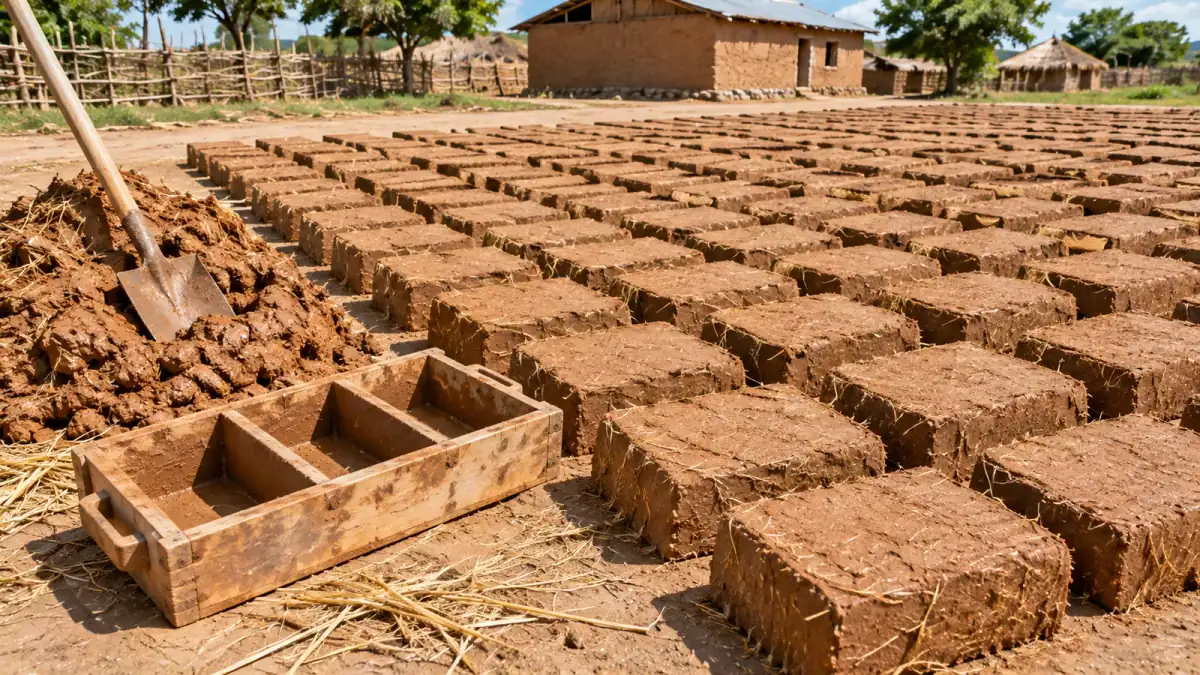
Use a bottomless wooden mould (single or multiple), wetted so mud releases. Throw mud firmly into the corners, strike off the top, lift the mould and repeat. Common sizes are around 250×350×100 mm for adobe, larger than fired bricks.
4. Dry and cure
Dry on flat, sanded ground, out of rain. Turn bricks on edge after a few days; stack loosely after about a week and let them dry fully for 2–4 weeks. A dry brick should not break when dropped from knee height onto its edge.
5. Build with protection
Lay on a waterproof foundation and plinth, use mud mortar of the same soil, and protect walls with roof overhangs and lime or earth plaster.
When to use a press instead
Hand moulding is slow and weather-dependent. A manual interlocking press or a hydraulic earth block machine uses damp (not wet) soil, compacts it under high pressure and ejects a brick ready to stack the same day — denser and more accurate, with less drying shrinkage. Read the CEB guide.
Machines for this application
- KDS2-40 Manual Interlocking Clay Brick Machine — Manual lever-press compressed earth block machine — no electricity required, perfect for remote community building.
- QTS2-10 Hydraulic Interlocking Earth Block Machine — Light 280 kg hydraulic earth block machine for interlocking clay and soil-cement bricks with optional crusher and sieve.
Moving from hand-made mud bricks to pressed bricks?
Send your target daily output, product sizes, local raw materials and voltage. Our engineers reply within 24 hours with a recommended configuration, layout and itemised quotation.
Frequently asked questions
What is the best mix for mud bricks?
Roughly 3–4 parts clayey soil to 1 part sand with chopped straw, adjusted by test bricks; add 5–10% cement or lime for stabilised adobe.
How long do mud bricks take to dry?
About 2–4 weeks depending on sun, wind and humidity.
What is the difference between adobe and compressed earth blocks?
Adobe is wet-moulded and sun-dried; CEB are pressed from damp soil at high pressure, giving denser and more uniform blocks.
Related guides
- Compressed Earth Blocks (CEB): Soil, Strength and Earth Block House Construction
- Compressed Earth Block Machine: Manual, Diesel and Automatic CEB Presses Compared
- How Are Bricks Made? Fired Clay, Concrete and Compressed Earth Bricks Compared
- Manual vs Hydraulic Brick and Block Press: Output, Strength and Cost Compared