Key takeaways
- Red (fired) clay brick plants need an extruder or moulding machine, cutter, dryer and kiln — a large, energy-intensive investment.
- Interlocking clay brick presses make unfired, cement- or lime-stabilised bricks — low investment and no kiln.
- Clay suitability and fuel cost usually decide between the two.
- Our clay brick range focuses on unfired interlocking presses and complete CEB lines.
“Clay brick making machine” can mean a vacuum extruder feeding a tunnel kiln, or a hydraulic press making interlocking soil bricks on a building site. The price difference is enormous, so define the product first.
Fired red brick lines
| Equipment | Function |
|---|---|
| Box feeder, crusher, roller mill | Prepare clay |
| Double-shaft mixer | Homogenise clay and water |
| Vacuum extruder | Form a dense clay column through a die |
| Cutter | Wire-cut bricks from the column |
| Setting machine and dryer | Load cars and dry green bricks |
| Kiln (Hoffmann, zigzag or tunnel) | Fire at roughly 900–1,100 °C |
These plants need large clay reserves, fuel supply and significant capital. Kilns: brick kiln types.
Unfired interlocking clay brick machines
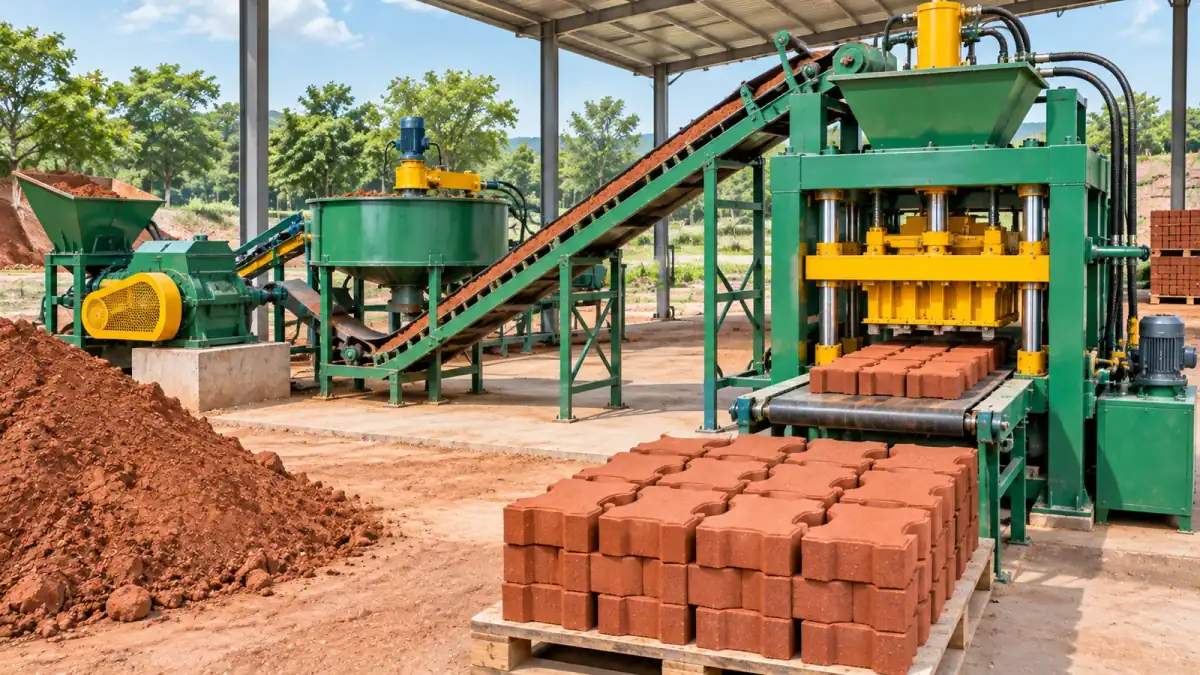
Interlocking clay brick presses compress soil with clay content (plus 5–10% cement or lime) at high pressure. Bricks cure without firing. Options range from the manual KDS2-40 and hydraulic KQ2-25 to the automatic QTS5-10 and the automatic clay brick production line with crusher, mixer and conveyor.
Fired vs unfired: decision table
| Factor | Fired red brick line | Interlocking clay brick press |
|---|---|---|
| Investment | High | Low |
| Energy | Kiln fuel | Press power only |
| Clay requirement | Plastic brick clay | Soil with 15–30% clay |
| Product | Red facing and common bricks | Interlocking soil-cement bricks |
| Markets | Established red-brick markets | Affordable housing, NGOs, self-build |
Clay brick machine price
Manual presses are the lowest investment; hydraulic presses cost several times more; automatic CEB lines more again — but all remain a fraction of a fired brick plant. For quotes, tell us your soil type, daily output and power supply. General pricing logic: what drives machine prices.
Machines for this application
- KQ2-25 Hydraulic Interlocking Clay Brick Machine — Hydraulic press for 2 interlocking bricks per 25-second cycle with 16 MPa pressure — diesel or electric power.
- QTS5-10 Automatic Interlocking Clay Brick Machine — Automatic hydraulic compressed earth brick machine: 16 MPa forming pressure, 7.5 kW and a 10-second cycle.
- Automatic Interlocking Clay Brick Production Line — Complete compressed earth brick line with crusher, mixer, conveyor and automatic hydraulic press for commercial output.
- KDS2-40 Manual Interlocking Clay Brick Machine — Manual lever-press compressed earth block machine — no electricity required, perfect for remote community building.
Tell us about your clay — we will suggest a machine
Send your target daily output, product sizes, local raw materials and voltage. Our engineers reply within 24 hours with a recommended configuration, layout and itemised quotation.
Frequently asked questions
What machine is used to make clay bricks?
Fired clay bricks use extruders, cutters, dryers and kilns; unfired interlocking clay bricks use hydraulic or manual presses.
Do interlocking clay bricks need a kiln?
No. They are stabilised with cement or lime and cured without firing.
Which is cheaper to start, fired or unfired bricks?
Unfired interlocking clay bricks require far less capital and energy.