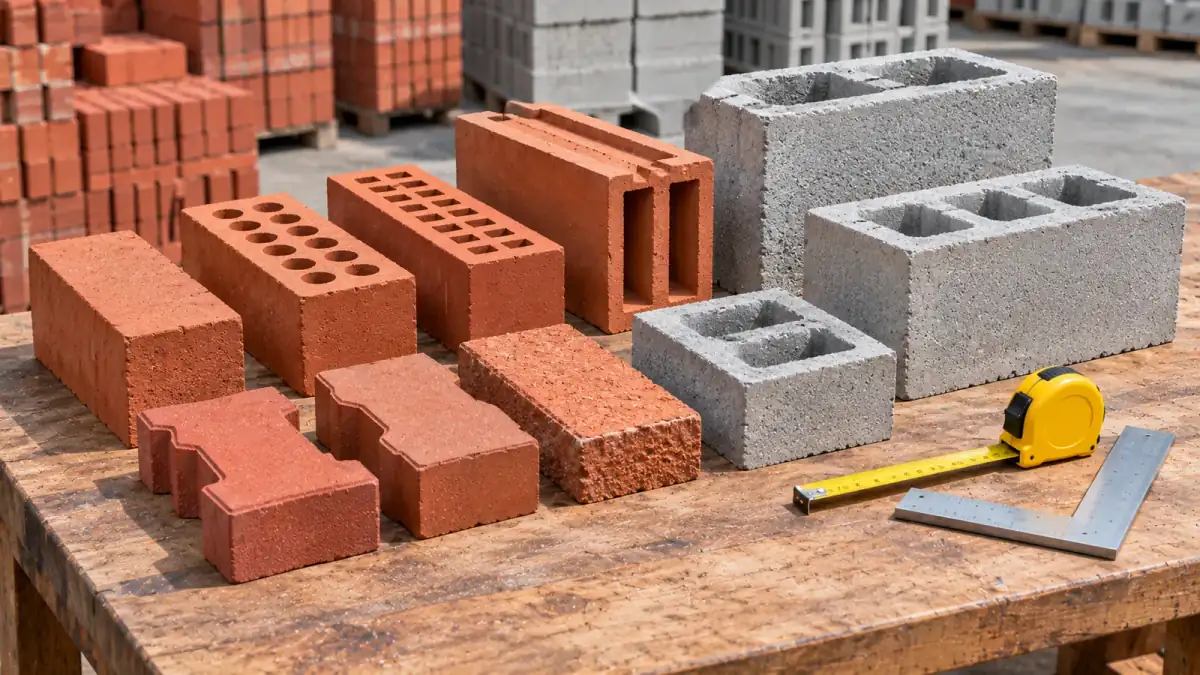
Key takeaways
- There is no single world brick size: the UK standard is 215×102.5×65 mm, the US modular brick 7⅝×3⅝×2¼ in, India’s modular brick 190×90×90 mm.
- Nominal sizes include a 10 mm (⅜ in) mortar joint.
- A good brick is uniform in size, sound when struck, low in absorption and free of cracks and soluble salts.
- Brick moulds for block machines are made to the local size.
Bricks are sized to fit a mason's hand and to bond into a wall module. Each country settled on its own size — which matters when you specify, import or produce bricks.
Brick sizes by country
| Country / type | Size (L × W × H) |
|---|---|
| USA — modular | 7⅝ × 3⅝ × 2¼ in (194 × 92 × 57 mm) |
| USA — standard | 8 × 3⅝ × 2¼ in (203 × 92 × 57 mm) |
| USA — queen / king | about 7⅝–9⅝ × 2¾–3 × 2¾ in |
| UK / Ireland | 215 × 102.5 × 65 mm |
| India — modular (IS 1077) | 190 × 90 × 90 mm (also 190 × 90 × 40) |
| India — conventional | about 230 × 110 × 70–75 mm |
| Australia | 230 × 110 × 76 mm |
| South Africa | 222 × 106 × 73 mm |
| Germany — NF / DF | 240 × 115 × 71 mm / 240 × 115 × 52 mm |
| China — standard | 240 × 115 × 53 mm |
Always confirm the current national standard; local market sizes can differ slightly.
Bricks per square metre
For a half-brick (single leaf) wall with 10 mm joints: UK bricks need about 60 per m²; US modular about 6.75 per ft² (about 73 per m²). Thicker walls multiply accordingly.
Characteristics of a good brick
- Uniform size and shape with sharp edges.
- Adequate compressive strength for its class.
- Water absorption within the standard's limits.
- Rings clearly when two bricks are struck together (fired clay).
- No cracks, lime nodules or excessive efflorescence.
Brick materials
Bricks are made from fired clay, concrete (cement-sand), calcium silicate (sand-lime), fly ash or stabilised soil. Production routes: how bricks are made; comparison: concrete vs clay bricks.
Producing bricks to local size
Concrete bricks are made on a block machine with a brick mould sized to your market — a machine like the QT4-24 forms many bricks per cycle. Send us your brick dimensions and we will confirm cavities per mould.
Machines for this application
- QT4-24 Block Making Machine — Small hydraulic block machine with a 24-second cycle — a proven choice for first-time block entrepreneurs.
- Paving & Interlocking Brick Mould — Precision paver moulds with textured tamper heads for Holland, zigzag, I-shape and custom paving stones.
- KQ2-25 Hydraulic Interlocking Clay Brick Machine — Hydraulic press for 2 interlocking bricks per 25-second cycle with 16 MPa pressure — diesel or electric power.
Need a brick mould for your local size?
Send your target daily output, product sizes, local raw materials and voltage. Our engineers reply within 24 hours with a recommended configuration, layout and itemised quotation.
Frequently asked questions
What is the standard size of a brick?
It depends on the country: UK 215×102.5×65 mm, US modular 7⅝×3⅝×2¼ in, India modular 190×90×90 mm, China 240×115×53 mm.
How many bricks are in a square metre?
About 60 UK-size bricks per m² of single-leaf wall with 10 mm joints.
What makes a good brick?
Uniform size, adequate strength, limited water absorption, no cracks or harmful salts.
Related guides
- Concrete Bricks vs Clay Bricks: Cost, Strength, Durability and Production
- Concrete Block Sizes and Dimensions: Imperial and Metric Size Chart
- How Are Bricks Made? Fired Clay, Concrete and Compressed Earth Bricks Compared
- Clay Brick Making Machine Options: Extrusion Lines vs Interlocking Clay Brick Presses