Key takeaways
- Concrete bricks are made from cement, sand and fine aggregate, vibro-pressed and cured — no kiln.
- Clay bricks are fired; they have lower drying shrinkage and colour-fast natural tones.
- Concrete bricks offer exact dimensions, consistent strength and low production capital.
- Design walls with movement joints suited to the material — concrete masonry shrinks slightly as it dries.
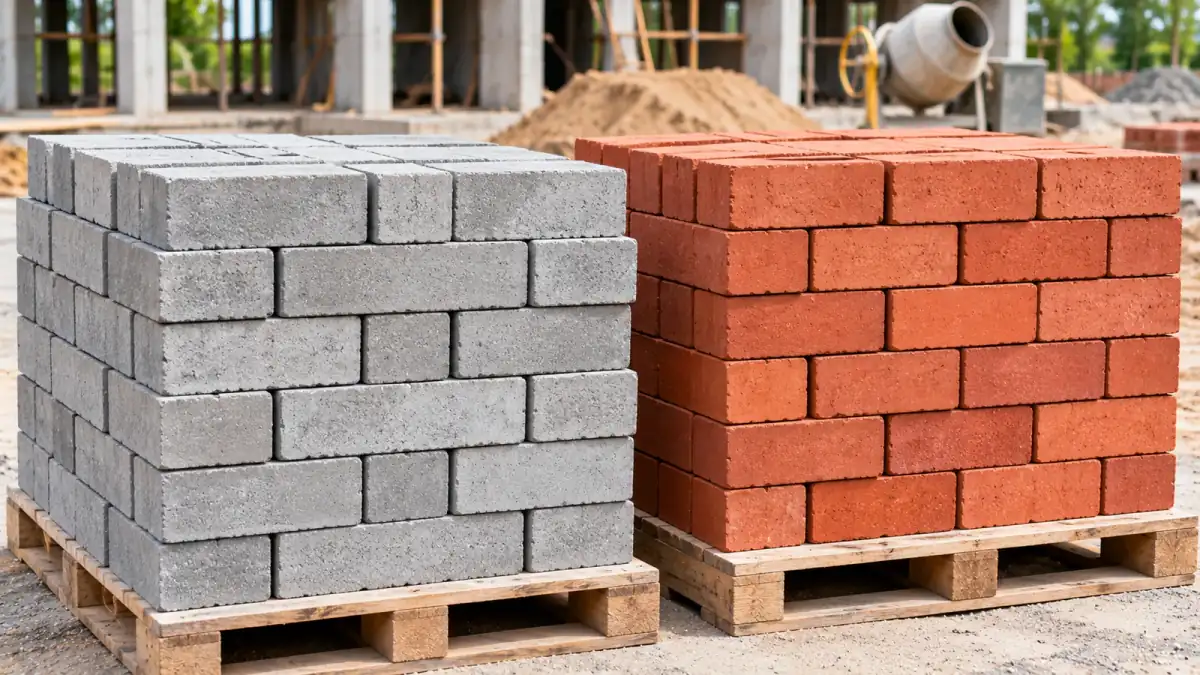
Concrete bricks have taken market share from clay bricks in many countries because they can be produced close to the market with modest investment. Here is how they compare.
Comparison
| Concrete (cement) brick | Fired clay brick | |
|---|---|---|
| Raw materials | Cement, sand, fine stone, optional fly ash | Clay, shale |
| Hardening | Cement curing | Kiln firing |
| Strength | Controllable through mix design | Depends on clay and firing |
| Dimensional accuracy | Very high | Good (extruded) to variable (hand-made) |
| Movement | Small drying shrinkage | Small moisture expansion |
| Colour | Pigmented, very wide range | Natural clay colours |
| Production capital | Low–medium | High (kiln, dryer) |
| US standard | ASTM C55 | ASTM C62 / C216 |
Cost
Cement is the main variable cost of concrete bricks; fuel is the main variable cost of clay bricks. Where cement is affordable and fuel expensive, concrete bricks usually win. Fly ash can replace part of the cement — see fly ash bricks.
Appearance
Clay bricks age well with stable natural colour. Concrete bricks can match many colours with iron oxide pigments and textured faces, though pigment selection and UV exposure matter for long-term colour.
How cement bricks are made
A cement brick making machine is a block machine with a brick mould: earth-moist mix is vibrated and pressed into many brick cavities per cycle, then the bricks are cured. A compact QT4-24 or automatic QT4-15 is a typical start; the same machine also makes hollow blocks and pavers. Process detail: how concrete blocks are made.
Machines for this application
- QT4-24 Block Making Machine — Small hydraulic block machine with a 24-second cycle — a proven choice for first-time block entrepreneurs.
- QT4-15 Automatic Hydraulic Block Making Machine — Entry-level fully automatic block machine with PLC control and hydraulic pressing — the lowest-cost way to move from manual to automatic production.
- Iron Oxide Pigment for Concrete Blocks & Pavers — Fe₂O₃ powder pigments in red, yellow, black, brown and blue for colour pavers, roof tiles and blocks — 25 kg bags.
Ready to produce cement bricks?
Send your target daily output, product sizes, local raw materials and voltage. Our engineers reply within 24 hours with a recommended configuration, layout and itemised quotation.
Frequently asked questions
Are concrete bricks stronger than clay bricks?
They can be made to equal or exceed many clay bricks through mix design; both vary by grade.
Are concrete bricks cheaper than clay bricks?
Often, where cement is affordable and kiln fuel is expensive. Production capital is also lower.
What machine makes cement bricks?
A concrete block machine fitted with a brick mould.