Key takeaways
- Fired clay bricks: clay is prepared, shaped by extrusion or moulding, dried, and fired in a kiln at roughly 900–1,100 °C.
- Concrete (cement) bricks: an earth-moist cement-aggregate mix is vibro-pressed in a block machine and cured — no firing.
- Compressed earth bricks: stabilised soil is pressed at high pressure and cured — no firing.
- The unfired routes need far less energy and capital, which is why they dominate new small-scale brick businesses.
Bricks have been made for thousands of years, but today three very different processes produce them. Which one suits you depends on raw materials, energy cost and what your market accepts.
1. Fired clay bricks
- Winning and preparation: clay and shale are excavated, weathered, crushed and mixed with water (and sometimes sand or additives).
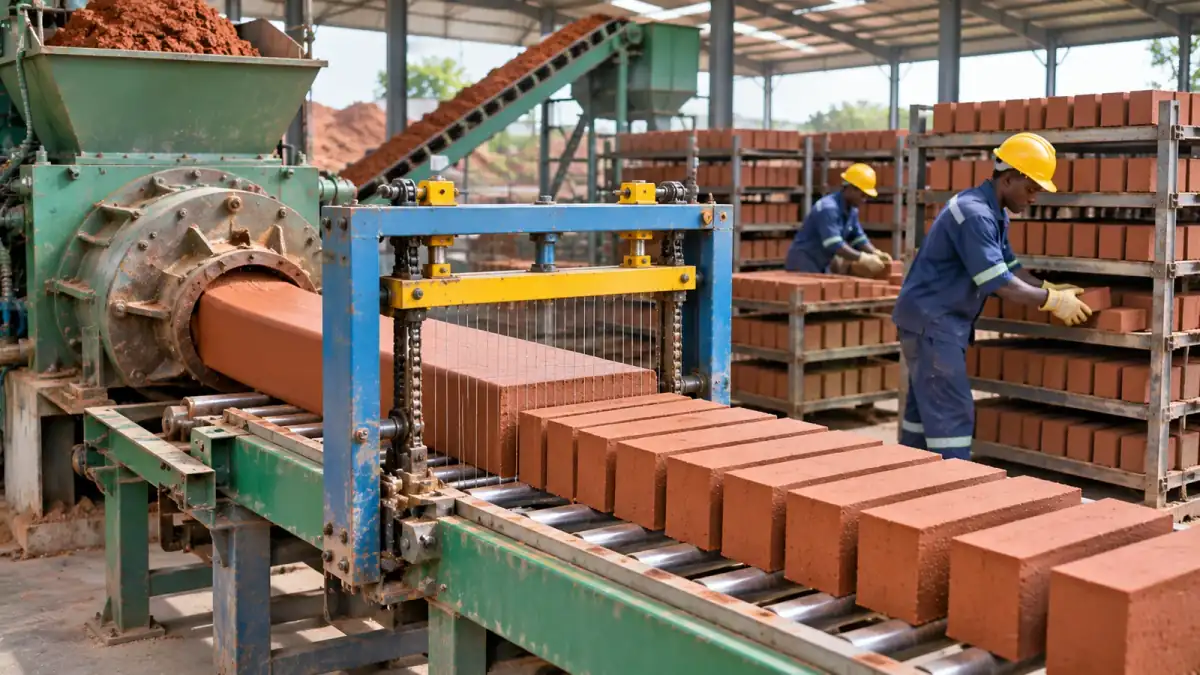
- Shaping: industrial plants extrude a continuous clay column through a die and wire-cut it into bricks (solid or perforated); traditional plants press clay into moulds by hand (soft-mud).
- Drying: green bricks lose most of their water in dryers or open air over days.
- Firing: bricks are fired in a kiln, typically around 900–1,100 °C, where the clay vitrifies. See brick kiln types.
- Cooling, sorting and packing.
2. Concrete (cement) bricks
- Batch cement, sand, fine stone (and optionally fly ash).
- Mix to an earth-moist consistency.
- Vibro-press in a block machine fitted with a brick mould — a small machine forms dozens of bricks per cycle.
- Cure moist for 7+ days.
Concrete bricks are dimensionally exact, can be coloured and are produced year-round. Machines: QT4-24 and up. Comparison: concrete vs clay bricks.
3. Compressed earth bricks
- Crush and sieve suitable soil (15–30% clay).
- Mix with 5–10% cement or lime and a little water.
- Press in a manual or hydraulic press, often with interlocking shapes.
- Cure under cover 7–14 days.
Presses: KQ2-25, QTS5-10. Guide: compressed earth blocks.
Comparison
| Fired clay | Concrete brick | Compressed earth | |
|---|---|---|---|
| Energy | High (kiln fuel) | Cement embodied energy | Low |
| Capital for a commercial plant | High | Low–medium | Low |
| Time to sale | Days–weeks | 1–4 weeks curing | 2–4 weeks curing |
| Raw material | Clay/shale | Cement, sand, stone | Local soil + stabiliser |
Making bricks at home
Home-made bricks are usually sun-dried mud (adobe) or cast concrete. Both are possible with simple wooden moulds — see how to make mud bricks — but for selling bricks, even a small machine multiplies output and consistency.
Machines for this application
- QT4-24 Block Making Machine — Small hydraulic block machine with a 24-second cycle — a proven choice for first-time block entrepreneurs.
- KQ2-25 Hydraulic Interlocking Clay Brick Machine — Hydraulic press for 2 interlocking bricks per 25-second cycle with 16 MPa pressure — diesel or electric power.
- QTS5-10 Automatic Interlocking Clay Brick Machine — Automatic hydraulic compressed earth brick machine: 16 MPa forming pressure, 7.5 kW and a 10-second cycle.
Choosing a brick technology for your market?
Send your target daily output, product sizes, local raw materials and voltage. Our engineers reply within 24 hours with a recommended configuration, layout and itemised quotation.
Frequently asked questions
How are bricks made step by step?
Fired clay bricks are prepared, shaped, dried and kiln-fired; concrete bricks are mixed, vibro-pressed and cured; earth bricks are mixed with stabiliser, pressed and cured.
At what temperature are clay bricks fired?
Typically around 900–1,100 °C, depending on the clay.
Do concrete bricks need firing?
No. They harden by cement hydration during curing.
Related guides
- Brick Kiln Types: Clamp, Zigzag, Hoffmann and Tunnel Kilns Compared
- Concrete Bricks vs Clay Bricks: Cost, Strength, Durability and Production
- How to Make Mud Bricks and Adobe Bricks — and When to Use a Brick Press Instead
- Clay Brick Making Machine Options: Extrusion Lines vs Interlocking Clay Brick Presses