Key takeaways
- A brick kiln fires dried clay bricks at roughly 900–1,100 °C so the clay sinters into a hard ceramic.
- Intermittent kilns (clamps, scove kilns) are simple but fuel-hungry; continuous kilns (zigzag, Hoffmann, tunnel) recover heat and fire more evenly.
- Tunnel kilns move bricks on cars through fixed temperature zones — the most controlled and the most capital-intensive.
- Unfired bricks (concrete or compressed earth) avoid the kiln entirely.
A kiln is a thermally insulated chamber for firing. For clay bricks, firing transforms dried clay into durable ceramic. Kiln choice drives fuel use, emissions and brick quality.
The firing process
- Water smoking (up to ~200 °C): remaining moisture leaves.
- Dehydration and oxidation (~400–900 °C): chemically bound water and organic matter burn off.
- Vitrification (~900–1,100 °C): particles fuse; strength develops.
- Cooling: controlled to avoid cracking.
Main kiln types
| Kiln | Operation | Fuel efficiency | Notes |
|---|---|---|---|
| Clamp / scove | Intermittent; bricks stacked with fuel, covered and burned | Low | Traditional, uneven quality |
| Bull's trench (BTK) | Continuous; fire moves around an oval trench | Moderate | Common in South Asia |
| Zigzag | Continuous; zigzag air path | Better than BTK, lower emissions | Widely adopted as a BTK upgrade |
| Hoffmann | Continuous; ring of chambers, fire moves chamber to chamber | Good | Permanent structure |
| Vertical shaft brick kiln (VSBK) | Bricks descend through a vertical shaft | Very good | Small footprint |
| Tunnel kiln | Cars move through preheat, firing and cooling zones | Very good, most controlled | Industrial plants, highest capital |
How a tunnel kiln works
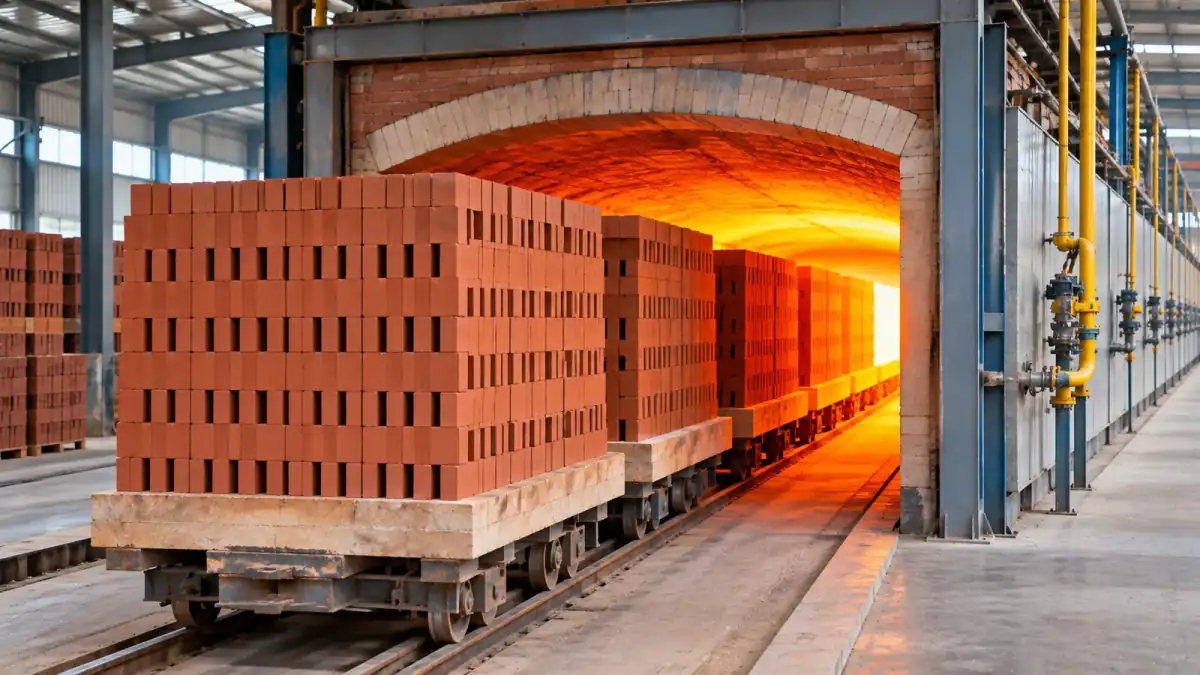
Dried bricks are stacked on kiln cars that move slowly through a long tunnel. Fresh air enters at the exit, cools the outgoing bricks and is itself heated; it then supports combustion in the firing zone, and hot gases preheat incoming bricks before being exhausted. The result is even firing and good heat recovery.
Kiln-free alternatives
Fuel cost and emission rules are pushing many markets toward unfired products: concrete bricks, fly ash bricks and compressed earth blocks, made on presses such as the QTS5-10. For other thermal processes we also supply rotary kiln cement lines and vertical shaft lime kilns.
Machines for this application
- QTS5-10 Automatic Interlocking Clay Brick Machine — Automatic hydraulic compressed earth brick machine: 16 MPa forming pressure, 7.5 kW and a 10-second cycle.
- Rotary Kiln Cement Production Line — EPC cement plants from 100 to 6,000 tonnes per day — crushing, raw mill, rotary kiln, cement mill and packing.
- Vertical Shaft Lime Kiln Production Line — Energy-saving vertical shaft kiln for active and hydrated lime, fired by natural gas, coal or producer gas.
Considering a kiln-free brick plant?
Send your target daily output, product sizes, local raw materials and voltage. Our engineers reply within 24 hours with a recommended configuration, layout and itemised quotation.
Frequently asked questions
What is a brick kiln?
A kiln used to fire dried clay bricks at high temperature so the clay hardens into ceramic.
What temperature is a brick kiln?
Clay bricks are typically fired at about 900–1,100 °C.
Which brick kiln is most efficient?
Continuous kilns with heat recovery — tunnel kilns and vertical shaft kilns — are among the most efficient.
Related guides
- How Are Bricks Made? Fired Clay, Concrete and Compressed Earth Bricks Compared
- Clay Brick Making Machine Options: Extrusion Lines vs Interlocking Clay Brick Presses
- Compressed Earth Blocks (CEB): Soil, Strength and Earth Block House Construction
- Concrete Bricks vs Clay Bricks: Cost, Strength, Durability and Production