Key takeaways
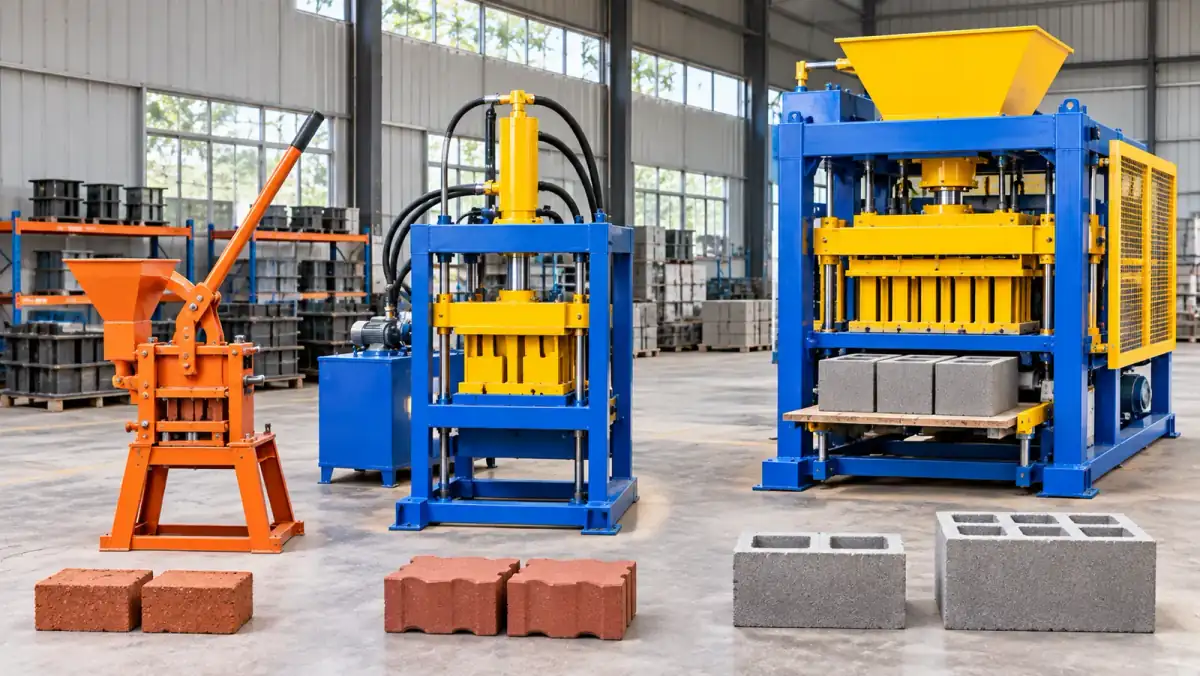
- “Brick making machine” covers three different technologies: concrete (cement) brick and block machines, unfired compressed earth/clay brick presses, and fired clay brick extrusion lines.
- For cement bricks and hollow blocks, the choice is manual → mobile → semi-automatic → fully automatic, driven by daily output and labour cost.
- Interlocking clay brick presses need suitable soil and little cement, and no kiln.
- Match the machine to the brick your market already buys — then to your power supply and workforce.
A “machine that makes bricks” can mean very different equipment. A builder in Kenya asking for a brick making machine may want an interlocking soil-brick press; a contractor in the Philippines may mean a hollow block machine; an investor in India may mean a fly ash brick plant. Before comparing prices, identify which family of brick production machine you need.
The three families of brick machines
| Family | Raw material | How bricks harden | Typical products |
|---|---|---|---|
| Concrete / cement brick & block machines | Cement, sand, crushed stone, fly ash | Cement hydration (curing) | Cement bricks, hollow and solid blocks, pavers, curbstones |
| Compressed earth (interlocking clay) brick presses | Soil with 15–30% clay + 5–10% cement or lime | Compaction + stabiliser curing, no firing | Interlocking soil-cement bricks, CEB |
| Fired clay brick lines | Clay and shale | Drying and firing in a kiln at roughly 900–1,100 °C | Red solid and perforated bricks |
This site focuses on the first two families — they need far less capital and energy than a fired-brick plant. For background on firing, see brick kiln types.
Manual brick making machines
Manual brick machines use a lever or screw to compact material in a mould. They need no electricity, which makes them useful for remote housing projects. Output is limited by operator effort — typically a few hundred to around a thousand bricks a day. The KDS2-40 manual interlocking brick machine is a typical example for soil-cement bricks.
Hydraulic brick presses
A hydraulic brick press replaces muscle with an electric or diesel-driven pump. Forming pressure is consistent (around 16 MPa on our CEB presses), so brick density and strength are repeatable. Diesel versions such as the KDS2-25D work off-grid. Read manual vs hydraulic machines for the trade-offs.
Mobile (egg-laying) brick and block machines
A mobile brick making machine travels on wheels across a smooth concrete floor and drops finished blocks directly on the ground. There are no pallets to buy and no stacking, so the start-up cost is very low; you do need a large flat curing area. See the mobile egg-laying range.
Semi-automatic cement brick machines
Semi-automatic machines form bricks or blocks on pallets with electric vibration (and often hydraulic pressing). Operators control feeding and cycle start, and carry pallets to the curing area. They are the most popular first machine for a block yard: simple, repairable locally and capable of 2,500–6,700 hollow blocks a shift — or many more small cement bricks, because a brick mould holds far more units per cycle.
Fully automatic brick making machines
An automatic brick making machine adds PLC control, automatic batching, pallet feeding and stacking. Output per worker rises sharply and quality is more consistent — essential when you supply contractors who test compressive strength or government projects. Lines such as the QT12-15 also produce two-layer colour pavers.
Which brick machine should you choose?
- Remote site, no grid power, soil available: manual or diesel interlocking clay brick press.
- Contractor building on site: mobile egg-laying machine.
- New block yard selling 2,000–7,000 blocks/day: semi-automatic QT4 series.
- Commercial plant, 10,000+ blocks/day, pavers and curbs: fully automatic QT8–QT15 line.
Small brick making machines are a sensible way to test a market, but plan your site so you can add a larger machine later without rebuilding the yard.
Machines for this application
- QT4-24 Block Making Machine — Small hydraulic block machine with a 24-second cycle — a proven choice for first-time block entrepreneurs.
- QTM4-30A Mobile Egg-Laying Block Machine — Portable egg layer that moves on wheels and lays 4 hollow blocks per cycle directly onto a concrete floor — no pallets needed.
- QT12-15 Automatic Block & Colour Paver Machine — Large-capacity automatic plant: 12 hollow blocks every 15 seconds, 36 kW total power and a 250–300 m² workshop footprint.
- QTS5-10 Automatic Interlocking Clay Brick Machine — Automatic hydraulic compressed earth brick machine: 16 MPa forming pressure, 7.5 kW and a 10-second cycle.
- KDS2-40 Manual Interlocking Clay Brick Machine — Manual lever-press compressed earth block machine — no electricity required, perfect for remote community building.
Not sure which brick machine fits your project?
Send your target daily output, product sizes, local raw materials and voltage. Our engineers reply within 24 hours with a recommended configuration, layout and itemised quotation.
Frequently asked questions
What is the best brick making machine for a small business?
For cement bricks and hollow blocks, a semi-automatic QT4 machine or a mobile egg-laying machine. For soil-based interlocking bricks, a hydraulic CEB press such as the KQ2-25 or QTS2-10.
Can one machine make bricks and blocks?
Yes. Concrete block machines change product by changing the mould, so the same machine can make cement bricks, hollow blocks, pavers and curbstones.
Do brick making machines need electricity?
Manual presses do not. Diesel hydraulic presses run off-grid. Semi-automatic and automatic machines need grid power or a generator sized about 1.5 times the connected load.
Related guides
- Block Making Machine Price: What Drives the Cost of a Block or Brick Machine
- Manual vs Hydraulic Brick and Block Press: Output, Strength and Cost Compared
- Compressed Earth Block Machine: Manual, Diesel and Automatic CEB Presses Compared
- How Are Bricks Made? Fired Clay, Concrete and Compressed Earth Bricks Compared