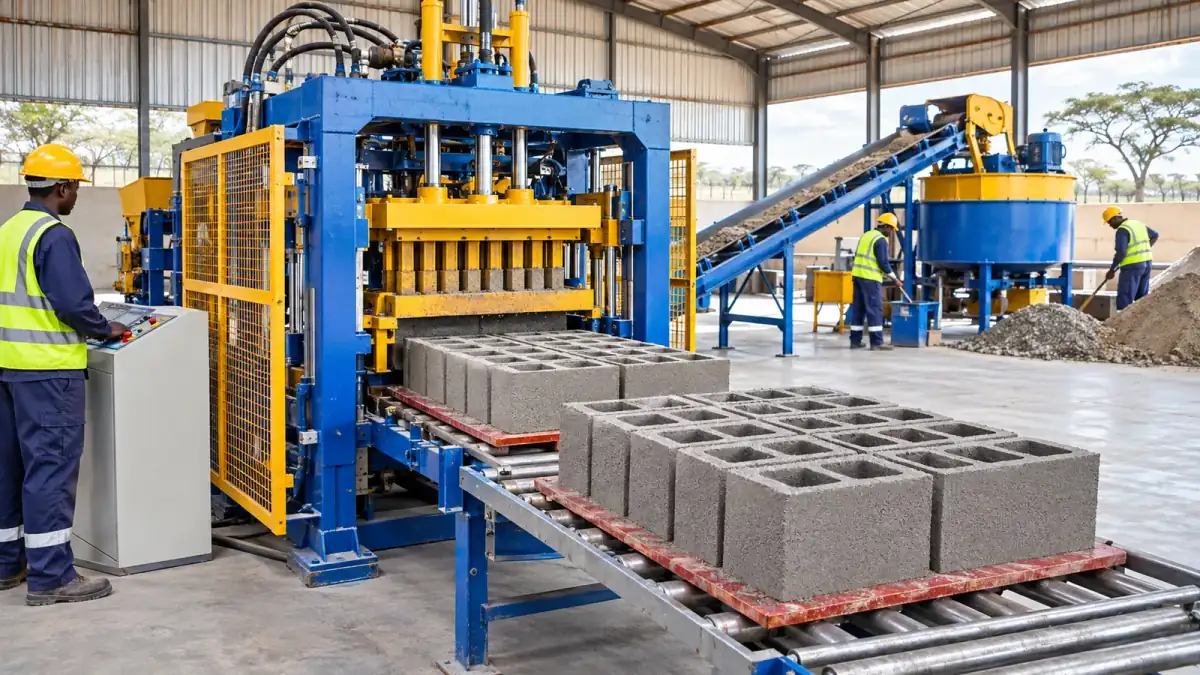
Key takeaways
- The price of a block making machine is set mainly by automation level and output per cycle — not by the brand name on the frame.
- The host machine is often less than half of a complete plant budget; mixer, batching, pallets, moulds, stacker and freight add the rest.
- Compare quotes only after normalising them to the same output (blocks per 8 h), the same mould set and the same scope of supply.
- Ask for an itemised quotation: a single lump-sum price hides what is and is not included.
“How much is a block making machine?” is the first question almost every buyer asks — and the honest answer is “it depends on what you include”. Two quotations for a “QT4 machine” can differ several times over because one is a bare host machine and the other is a complete line with mixer, pallets, moulds and installation. This guide explains what drives the block making machine price, so you can compare offers on equal terms and budget your whole plant, not just the machine.
Price tiers by automation level
Every concrete block machine, cement block machine or cinder block machine sold for export falls into one of four tiers. Within each tier price rises with output per cycle and vibration force.
| Tier | Typical models | Output (hollow 400×200×200, 8 h) | Relative price | What the price includes |
|---|---|---|---|---|
| Manual / small hydraulic press | Manual lever presses, small CEB presses | 500–2,000 | Lowest | Press and one mould; no electrics or a small engine |
| Mobile egg-laying | QTM4-30A, QTM6-24, QTM10-25 | 2,500–9,000 | Low | Machine on wheels, mould; no pallets needed |
| Semi-automatic | QT4-40, QT4-23A, QTJ4-35B | 2,500–6,700 | Low–medium | Host machine, mould, often a small mixer and conveyor |
| Fully automatic line | QT5-15 to QT15-15 | 7,000–28,000+ | Medium–high | Batching, mixer, conveyor, host, pallet feeder, stacker, PLC |
Because local taxes, freight and specification differ so much, we do not publish a single list price. What we can say reliably is the ratio: moving from a semi-automatic machine to a fully automatic line multiplies output per worker by three to five, and multiplies the equipment budget by a similar factor. Your sales volume decides which tier pays back fastest — see our cost and profit method.
Seven factors that move the price
- Blocks per cycle. The first number in a model name (the “10” in QT10-15) is the count of 400×200×200 mm hollow blocks formed per cycle. A larger mould table needs a heavier frame, stronger vibration and more hydraulic capacity.
- Forming method. Hydraulic pressure plus platform vibration costs more than vibration-only forming, but gives denser blocks with sharper edges — important for pavers and load-bearing units.
- Control system. A PLC with touch screen and automatic pallet feeding is more expensive than manual relay control, and saves labour every shift.
- Mould set. Each block type needs its own mould. A quote with one hollow-block mould is not comparable to one with hollow, solid, paver and curbstone moulds.
- Pallets. Semi-automatic plants need roughly 600–1,000 pallets; automatic lines 1,000–2,000. Pallet material (PVC, GMT, steel, wood) can swing the plant budget noticeably — compare them in our pallet guide.
- Auxiliary equipment. Batching machine, twin-shaft mixer, cement silo and screw conveyor, stacker, face-mix feeder for colour pavers, and a forklift or wheel loader.
- Logistics and service. Container count, inland freight at destination, engineer travel for installation and spare-parts packages.
A complete plant budget, line by line
Use this checklist when you request quotations. Ask every supplier to price each line separately.
| Budget line | Questions to ask |
|---|---|
| Host block machine | Blocks per cycle, cycle time, vibration force, motor power, frame steel thickness |
| Moulds | Which block sizes, mould steel grade, heat treatment, guaranteed cycles |
| Mixer and batching | Mixer model and batch volume; number of aggregate bins; weighing accuracy |
| Conveying and stacking | Belt length, pallet feeder, stacker or cuber included? |
| Pallets | Quantity, material, thickness, warranty |
| Electrics | PLC brand, voltage and frequency, cable package |
| Spare parts | Wear-part list for the first year |
| Installation and training | Number of engineer-days, who pays travel and accommodation |
| Packing and freight | FOB or CIF port, number of 20' / 40' containers |
How to compare two quotations fairly
- Normalise output. Convert each offer to blocks per 8-hour shift for the same block size: blocks per cycle × (3,600 ÷ cycle seconds) × 8 × 0.75 efficiency. Our capacity calculator does this for every model.
- Normalise scope. Strike out any line one supplier includes and the other does not, or add a market price for it.
- Check the vibration and hydraulic specs. A cheaper machine with low vibration force makes lighter, weaker blocks and will burn more cement per block to hit strength — a cost that repeats every day.
- Ask for a running video. A factory test-run video of your exact configuration before shipment protects your deposit.
New, used or refurbished?
Searches for “used concrete block making machine for sale” are common, especially in the USA. A used machine can make sense if you can inspect it running and spare parts are still available; otherwise worn moulds, guide columns and vibration bearings can cost more than the saving. Read our used vs new block machine checklist.
Brick machine prices: concrete, clay and earth
The same logic applies to a brick making machine. A cement brick making machine is simply a concrete block machine fitted with a brick mould (e.g. 240×115×53 mm, many bricks per cycle). Clay brick manufacturing machine prices split into two very different worlds: fired clay brick plants with extruders, cutters, dryers and a kiln (large investments), and unfired interlocking clay brick presses such as the KQ2-25 or manual KDS2-40, which cost a small fraction and need no kiln. See clay brick making machine options.
Machines for this application
- QT4-40 Semi-Automatic Block Making Machine — The classic low-cost block machine: 4 hollow blocks per 40-second cycle, 16.3 kW and a footprint of just 1350 × 1460 mm.
- QT4-23A Semi-Automatic Hydraulic Block Machine — Hydraulic-assisted semi-automatic machine with a 24-second cycle — up to 6,720 blocks a day in a 60 m² workshop.
- QTM6-24 Hydraulic Movable Block Machine — Hydraulic egg-laying machine with operator cab and sun canopy: 6 hollow blocks every 20–30 seconds.
- QT5-15 Automatic Concrete Block Machine Line — Best-selling mid-size automatic line: 5 hollow blocks per 15-second cycle with a 1050 × 520 mm moulding area and 100 kN vibration.
- QT10-15 Fully Automatic Block Production Line — High-output automatic line producing 10 hollow blocks per cycle, designed to use fly ash and industrial by-products to lower raw-material cost.
Want two comparable quotations for your output?
Send your target daily output, product sizes, local raw materials and voltage. Our engineers reply within 24 hours with a recommended configuration, layout and itemised quotation.
Frequently asked questions
How much does a block making machine cost?
It depends on automation level, output per cycle and scope of supply. Manual and mobile machines are the lowest investment, semi-automatic machines sit in the middle, and fully automatic lines with batching, pallets and stacking cost the most. Send your target output for an itemised quotation.
Why do block machine quotes differ so much?
Usually because the scope differs: one quote covers only the host machine, another includes mixer, moulds, pallets, stacker, spare parts and installation. Compare line by line at the same output.
Is a cheaper block machine more profitable?
Not necessarily. Low vibration force or poor moulds raise cement consumption and breakage every day, which can outweigh a lower purchase price within months.
What is included in a complete block plant?
Typically batching, mixer, conveyor, block machine, pallets, moulds, stacker or forklift, electrics, spare parts and installation support.