Key takeaways
- Manual presses need no power and cost least, but output and density depend on the operator.
- Hydraulic presses deliver consistent pressure (around 16 MPa on our CEB presses), so bricks are denser, stronger and more uniform.
- For more than a few hundred bricks a day, or for bricks sold to engineers, choose hydraulic.
A brick press compacts a damp mix into a mould. The question is what supplies the force: a person on a lever, or a hydraulic pump. The choice affects output, brick quality and how much stabiliser (cement) you need for the same strength.
How each press works
Manual brick press: the operator fills the mould, closes the lid and pulls a long lever that multiplies his force through a linkage. A second lever stroke ejects the brick. No electricity or fuel is needed.
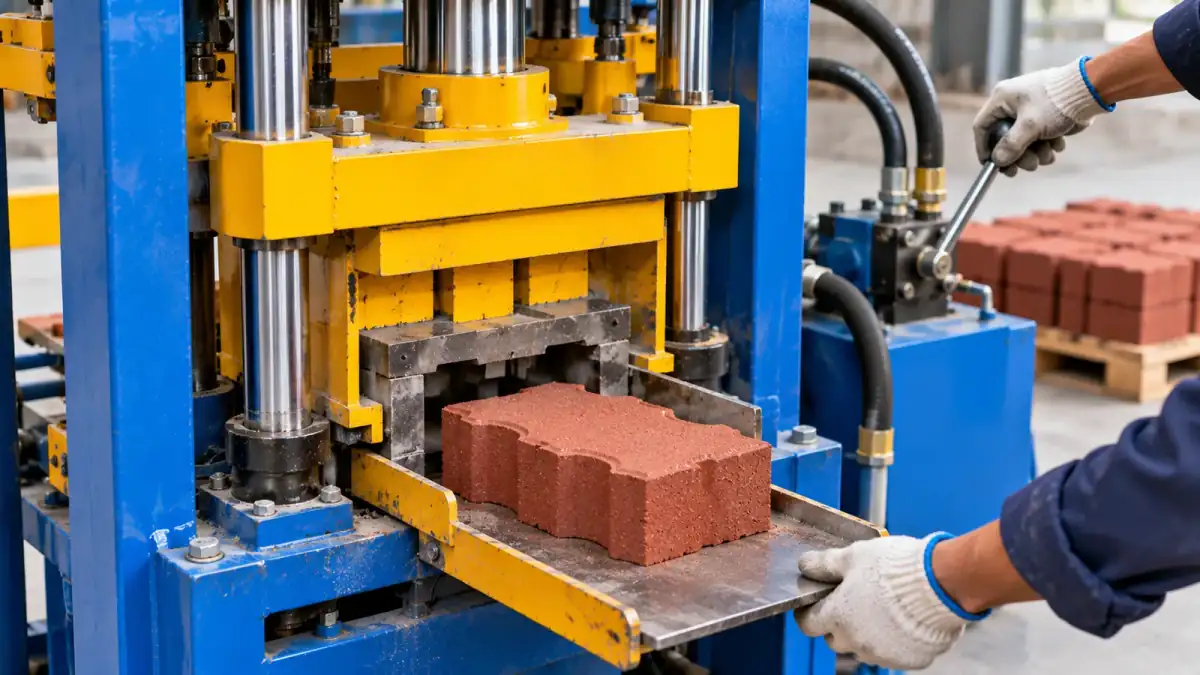
Hydraulic brick press: an electric motor or diesel engine drives a pump; a hydraulic cylinder compresses the mix at a set pressure and ejects the brick. Cycle times of 10–25 seconds are typical.
Side-by-side comparison
| Manual press | Hydraulic press | |
|---|---|---|
| Power | None | Electric motor or diesel engine |
| Forming pressure | Varies with operator | Constant, set by the relief valve |
| Output | Hundreds of bricks/day | Thousands of bricks/day |
| Brick density | Lower, variable | Higher, uniform |
| Cement needed for target strength | More | Less |
| Maintenance | Pins and bushings | Hydraulic oil, seals, filters |
| Best for | Remote, community and self-build projects | Commercial yards and housing programmes |
For compressed earth and mud bricks
Most “mud brick making machine” and “brick press machine” searches relate to soil bricks. The KDS2-40 is a manual interlocking press; the KQ2-25 and QTS2-10 are hydraulic. Higher compaction lets you reach the same strength with less cement — often the largest running cost. See the CEB machine guide.
For concrete blocks
For cement blocks, vibration matters as much as pressure. Manual concrete block machines exist, but a small vibrating machine such as the QT4-24 or the hydraulic QT4-18 produces far denser blocks per labour hour.
How to decide
- No reliable power and under ~500 bricks a day: manual.
- Selling bricks commercially or need consistent strength: hydraulic.
- Off-grid but commercial: diesel hydraulic, such as the KDS2-25D.
Machines for this application
- KDS2-40 Manual Interlocking Clay Brick Machine — Manual lever-press compressed earth block machine — no electricity required, perfect for remote community building.
- KQ2-25 Hydraulic Interlocking Clay Brick Machine — Hydraulic press for 2 interlocking bricks per 25-second cycle with 16 MPa pressure — diesel or electric power.
- QTS2-10 Hydraulic Interlocking Earth Block Machine — Light 280 kg hydraulic earth block machine for interlocking clay and soil-cement bricks with optional crusher and sieve.
- QT4-18 Hydraulic Block Machine — Hydraulic machine with a 15–20-second cycle that bridges semi-automatic and fully automatic production.
Choosing between a manual and a hydraulic press?
Send your target daily output, product sizes, local raw materials and voltage. Our engineers reply within 24 hours with a recommended configuration, layout and itemised quotation.
Frequently asked questions
Is a hydraulic brick press worth the extra cost?
For commercial production, yes: higher, consistent pressure gives stronger bricks with less cement and several times the daily output.
Can a manual brick press make interlocking bricks?
Yes. Manual presses such as the KDS2-40 make interlocking soil-cement bricks without electricity.
What pressure does a hydraulic brick press use?
Our hydraulic CEB presses work at about 16 MPa forming pressure.
Related guides
- Compressed Earth Block Machine: Manual, Diesel and Automatic CEB Presses Compared
- Brick Making Machine Types: How Each Works and Which One to Buy
- Compressed Earth Blocks (CEB): Soil, Strength and Earth Block House Construction
- How to Make Mud Bricks and Adobe Bricks — and When to Use a Brick Press Instead