Key takeaways
- Concrete products machinery falls into four groups: material handling, forming machines, curing systems and consumables.
- One block machine can make many products; roof tiles, pipes and AAC need dedicated machines.
- Pallets and moulds are recurring costs — budget for them as carefully as for the machine.
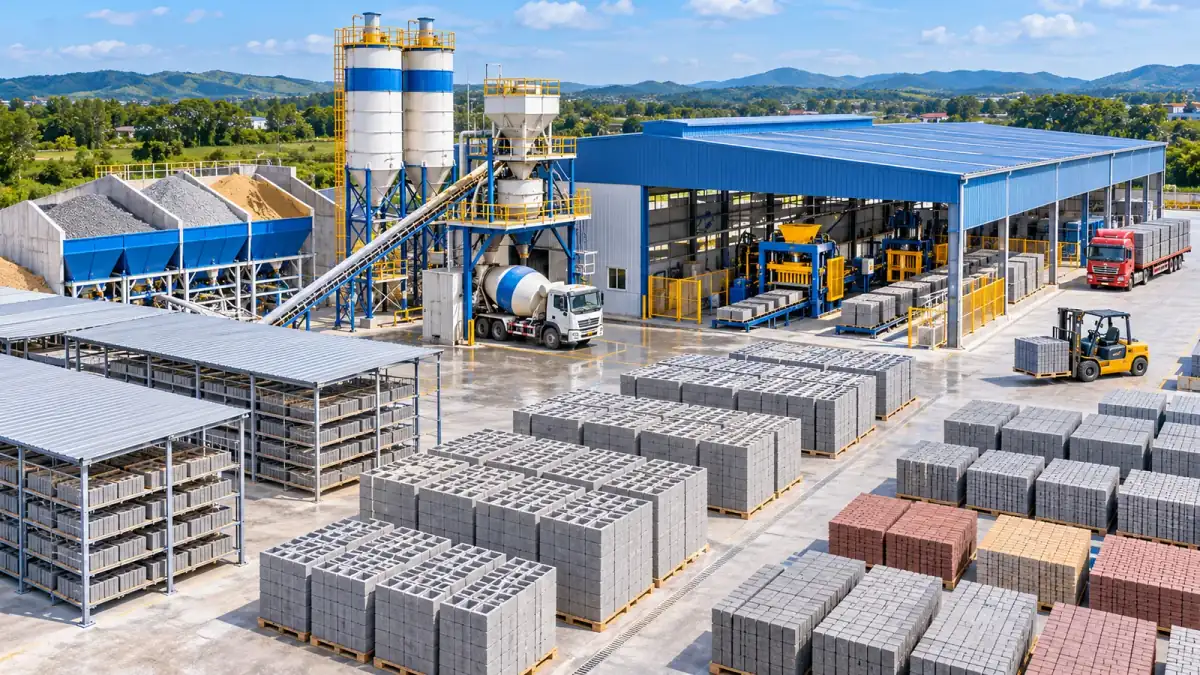
Search for “concrete machines” and you will find everything from hand mixers to slipform pavers. For a manufacturer of precast concrete products, the relevant equipment is narrower: the machinery that turns cement and aggregates into blocks, pavers, curbs, tiles, pipes and panels. This overview maps the equipment, so you can see where each machine fits.
1. Material handling and mixing
- Batching machine — weighs sand and stone from 2–4 bins.
- Cement silo and screw conveyor — stores and feeds bulk cement.
- Forced-action mixer — pan or twin-shaft (JS series) for earth-moist block concrete.
- Belt conveyors and bucket elevators — move mix and bulk materials.
- Wheel loader — feeds aggregate bins; see our ZL946.
2. Forming machines
| Machine | Products | Range |
|---|---|---|
| Block and paver machine (vibro-press) | Hollow and solid blocks, bricks, pavers, curbstones, hourdis | Automatic, semi-automatic, mobile |
| Compressed earth brick press | Interlocking soil-cement bricks | CEB machines |
| Roof tile machine | Concrete roof and ridge tiles, terrazzo | Roof tile machines |
| Pipe and pole machine | Drainage pipes 300–3,000 mm, poles | Pipe machine |
| AAC plant | Autoclaved aerated blocks and panels | AAC line |
3. Curing systems
From simple shade-net yards with sprinklers to insulated curing chambers with low-pressure steam, and — for AAC — high-pressure autoclaves. The curing method sets how many pallets you need and how quickly you can deliver.
4. Consumables and wear parts
- Pallets: GMT, PVC, steel or wood.
- Moulds: block moulds and paver moulds, wear parts measured in cycles.
- Pigments: iron oxide for coloured pavers and tiles.
How to choose a concrete equipment manufacturer
- Ask for a plant layout of your site, not just a machine quote.
- Check that moulds and pallets match the machine and are available as spares.
- Request a factory test-run video before shipment.
- Confirm installation, training and spare-parts support in writing.
Machines for this application
- QT10-15 Fully Automatic Block Production Line — High-output automatic line producing 10 hollow blocks per cycle, designed to use fly ash and industrial by-products to lower raw-material cost.
- KQ-20 Extrusion Concrete Roof Tile Machine — Roll-forming extrusion line that produces 20 coloured concrete roof tiles per minute under PLC control.
- Concrete Pipe & Pole Making Machine — Centrifugal and roller-suspension machines for 300–3000 mm drainage pipes and 7–18 m concrete poles.
- AAC Block Production Line (Autoclaved Aerated Concrete) — Turnkey autoclaved aerated concrete plant from 30,000 to 300,000 m³ per year, with cutting machines from 2 m to 6 m.
- GMT Glass-Fibre Block Machine Pallet — Glass-fibre reinforced thermoplastic pallets with double-polished surfaces (1.00 mm flatness) and an 8-year warranty.
Need a complete concrete products plant?
Send your target daily output, product sizes, local raw materials and voltage. Our engineers reply within 24 hours with a recommended configuration, layout and itemised quotation.
Frequently asked questions
What machines are needed for a concrete block plant?
A batching machine, mixer, conveyor, block machine with moulds, pallets, a stacker or forklift and a curing area. Fully automatic lines integrate these under PLC control.
Can one machine make blocks, pavers and curbstones?
Yes, a vibro-press block machine changes product by changing the mould. Roof tiles, pipes and AAC need different machines.