Key takeaways
- Paver blocks are vibro-pressed from a richer, well-graded earth-moist concrete than hollow blocks.
- Two-layer pavers have a coarse structural base and a fine coloured face mix, pressed together in one cycle.
- Strength targets are high — for example ASTM C936 requires an average of 8,000 psi (55 MPa) — so compaction, mix and curing all matter.
- Any automatic block machine can make pavers; a face-mix feeder is needed for two-layer colour pavers.
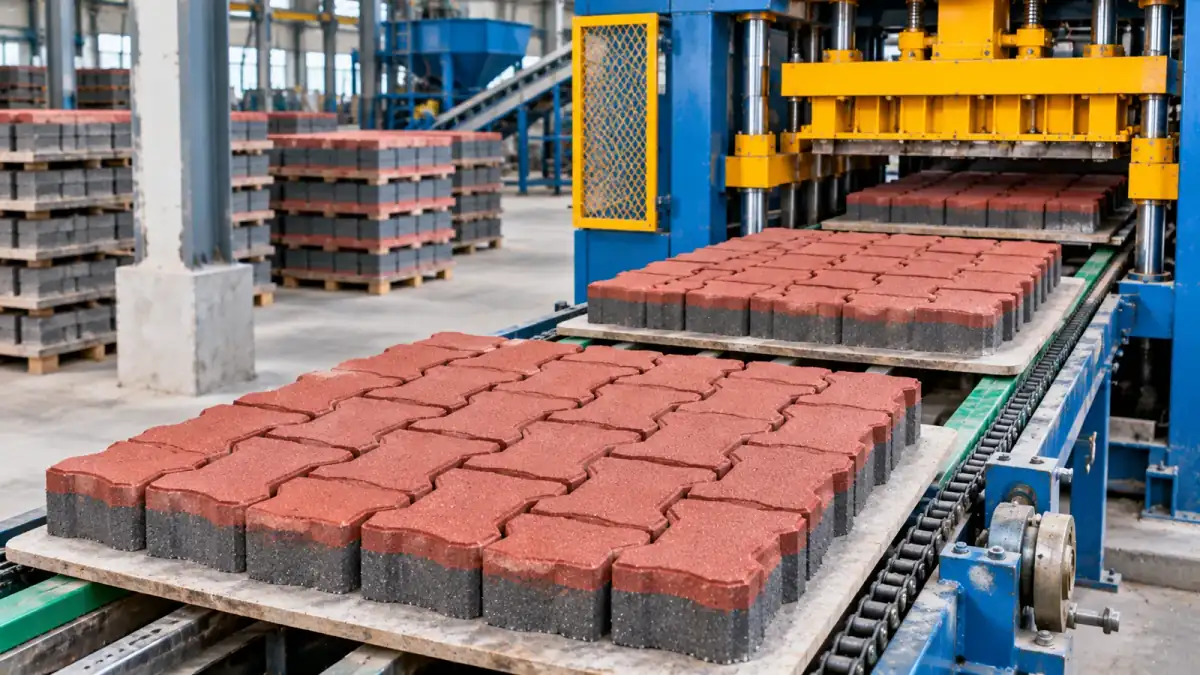
Interlocking concrete pavers carry cars, trucks and container handlers. That load comes through a small paver, so pavers need much higher strength and abrasion resistance than wall blocks. Here is how they are made.
Materials and mix
- Cement: higher content than blocks — a starting ratio around 1:3 to 1:4 cement to aggregates.
- Aggregates: clean sand and 0–6/8 mm crushed stone, well graded.
- Face mix (two-layer pavers): cement, fine sand (0–2 mm) and pigment.
- Water: earth-moist; slightly wetter for the face mix.
Starting recipes: concrete block and paver mix ratios.
The production process
- Batching and mixing — base and face mixes in separate mixers on two-layer lines.
- Base fill — the main feeder fills the mould to about 85–90% of height.
- Pre-compaction — short vibration.
- Face fill — the face-mix feeder adds a thin coloured layer.
- Vibro-compaction — hydraulic press and strong vibration together, bonding both layers.
- Demoulding — pavers leave on the pallet with exact height.
- Curing — at least 7 days moist, or steam curing; see curing guide.
- Cubing and packing — stacked into cubes, strapped and wrapped.
Paver block making machines
Paver output is quoted in m² per shift. Machines like the QT12-15 combine high vibration force, hydraulic pressing and an optional face-mix feeder. Smaller producers make single-layer pavers on semi-automatic machines and add colour through the whole mix (using more pigment). Moulds: paver molds.
Quality control
| Test | Why |
|---|---|
| Compressive or splitting tensile strength | EN 1338 uses splitting tensile strength; ASTM C936 compressive |
| Water absorption | Durability and freeze-thaw resistance |
| Abrasion resistance | Wear under traffic |
| Dimensions and thickness | Laying accuracy |
Making pavers by hand
To make your own concrete pavers for a patio or sidewalk, cast a wetter mix into plastic molds, vibrate or tap, cover and demould after 24–48 hours. Hand-made pavers suit garden paths; for driveways and roads, buy or produce machine-pressed pavers.
Machines for this application
- QT12-15 Automatic Block & Colour Paver Machine — Large-capacity automatic plant: 12 hollow blocks every 15 seconds, 36 kW total power and a 250–300 m² workshop footprint.
- QT10-15 Fully Automatic Block Production Line — High-output automatic line producing 10 hollow blocks per cycle, designed to use fly ash and industrial by-products to lower raw-material cost.
- Paving & Interlocking Brick Mould — Precision paver moulds with textured tamper heads for Holland, zigzag, I-shape and custom paving stones.
- Iron Oxide Pigment for Concrete Blocks & Pavers — Fe₂O₃ powder pigments in red, yellow, black, brown and blue for colour pavers, roof tiles and blocks — 25 kg bags.
Planning a paver block plant?
Send your target daily output, product sizes, local raw materials and voltage. Our engineers reply within 24 hours with a recommended configuration, layout and itemised quotation.
Frequently asked questions
What is the mix ratio for paver blocks?
A common starting point is about 1 part cement to 3–4 parts well-graded aggregates, earth-moist, confirmed by strength testing.
How are two-layer pavers made?
A coarse base mix fills most of the mould, then a fine coloured face mix is added and both are vibro-pressed together.
Can a block machine make pavers?
Yes, with a paver mould. A face-mix feeder adds two-layer colour capability.
Related guides
- Concrete Paver Molds: Machine Moulds vs Plastic Molds for Paving Stones
- Concrete Block Mix Ratio: Proven Recipes for Hollow Blocks, Solid Bricks and Pavers
- How to Cure Concrete Blocks: Natural, Covered and Steam Curing Explained
- Concrete Curb Machine Guide: Slipform Curbing Machines vs Precast Curbstone Machines