Key takeaways
- Two different technologies share the name “curb machine”: slipform machines that extrude curb in place, and precast curbstone (kerb) production on block machines.
- Landscape curbing machines are small extruders for garden borders; curb-and-gutter slipform pavers are road-building equipment.
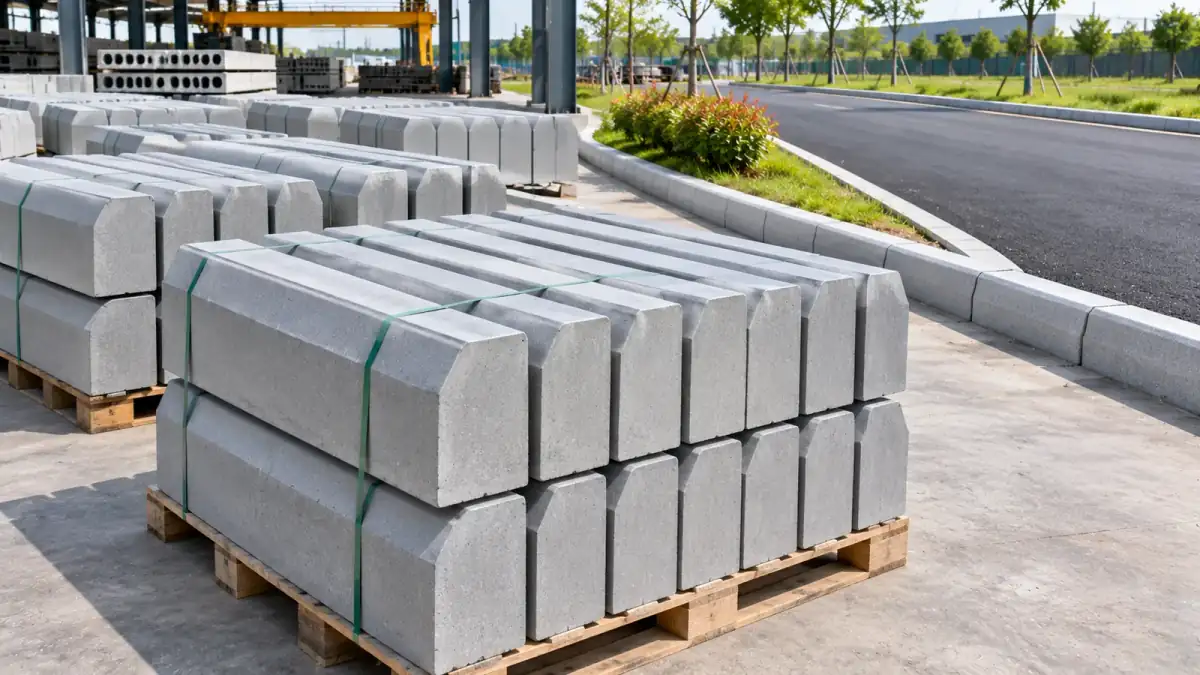
- Precast curbstones are vibro-pressed in moulds on automatic block machines and sold by the piece to road contractors.
- We supply precast curbstone production — not slipform machines.
“Concrete curb machine” searches come from two very different buyers: landscapers who extrude decorative borders in a garden, and producers who manufacture precast kerbs for roads. Knowing which machine you need saves an expensive mistake.
Three kinds of curb machine
| Type | How it works | Typical users |
|---|---|---|
| Landscape curbing machine (concrete edger) | Small walk-behind extruder pushes a continuous border of stiff concrete through a profile die | Landscaping contractors |
| Slipform curb and gutter machine | Large tracked machine slipforms curb, gutter or barriers in place | Road and highway contractors |
| Precast curbstone machine | Vibro-press block machine with curb moulds forms individual kerb units | Precast and block producers |
Slipform and extruded curbs
Extruded curbing is continuous and seamless and is formed on site. It suits garden edging and long, uniform road runs. The producer earns from installation services rather than selling products.
Precast curbstones (kerbs)
Precast kerbs are made in a factory, cured and delivered. They are standard in many countries for roads, car parks and pavements, specified to standards such as EN 1340 or national equivalents. Advantages: consistent quality, factory curing, replaceable units, and production all year regardless of site weather.
How precast curbstones are made on a block machine
- A curb mould (one to several kerbs per cycle depending on size and machine) is fitted to the block machine.
- Earth-moist concrete — often two-layer with a hard-wearing face — fills the mould.
- Vibration and hydraulic pressing compact the kerb; it is demoulded onto a pallet.
- Kerbs are cured, then stacked on pallets for delivery.
Kerbs are taller than blocks, so the machine needs sufficient mould height and vibration. Lines such as the QT12-15 and QT15-15 produce curbstones alongside blocks and pavers — one plant, three product lines.
Which business model?
- Landscaping services: a landscape curbing machine (rented or bought locally).
- Road contracting: slipform curb and gutter machines.
- Manufacturing: precast curbs, pavers and blocks on one automatic block line — the model we support.
Machines for this application
- QT12-15 Automatic Block & Colour Paver Machine — Large-capacity automatic plant: 12 hollow blocks every 15 seconds, 36 kW total power and a 250–300 m² workshop footprint.
- QT15-15 Large Automatic Block Production Line — Our largest QT model: 15 hollow blocks per cycle, 100 kN vibration and a 1100 × 900 mm pallet for industrial-scale block plants.
- Paving & Interlocking Brick Mould — Precision paver moulds with textured tamper heads for Holland, zigzag, I-shape and custom paving stones.
Want to produce precast curbstones?
Send your target daily output, product sizes, local raw materials and voltage. Our engineers reply within 24 hours with a recommended configuration, layout and itemised quotation.
Frequently asked questions
What is a concrete curb machine?
Either a slipform/extrusion machine that forms curb continuously in place, or a block machine with curb moulds that produces precast curbstones.
Can a block making machine make curbstones?
Yes. Automatic block machines with curb moulds and adequate mould height produce precast curbstones.
Do you sell landscape curbing machines?
No. We supply machines and moulds for precast curbstone production.