Key takeaways
- Plastic, rubber and silicone paver molds are for wet-cast pavers: low cost, slow (one paver per mold per day) and lower strength.
- Steel machine moulds form vibro-pressed pavers in seconds, with the density needed for driveway and road traffic.
- Tamper heads can carry textures, chamfers and logos; face-mix systems create two-layer coloured pavers.
- For commercial supply, paver strength standards (e.g. EN 1338, ASTM C936) are only realistic with machine-pressed pavers.
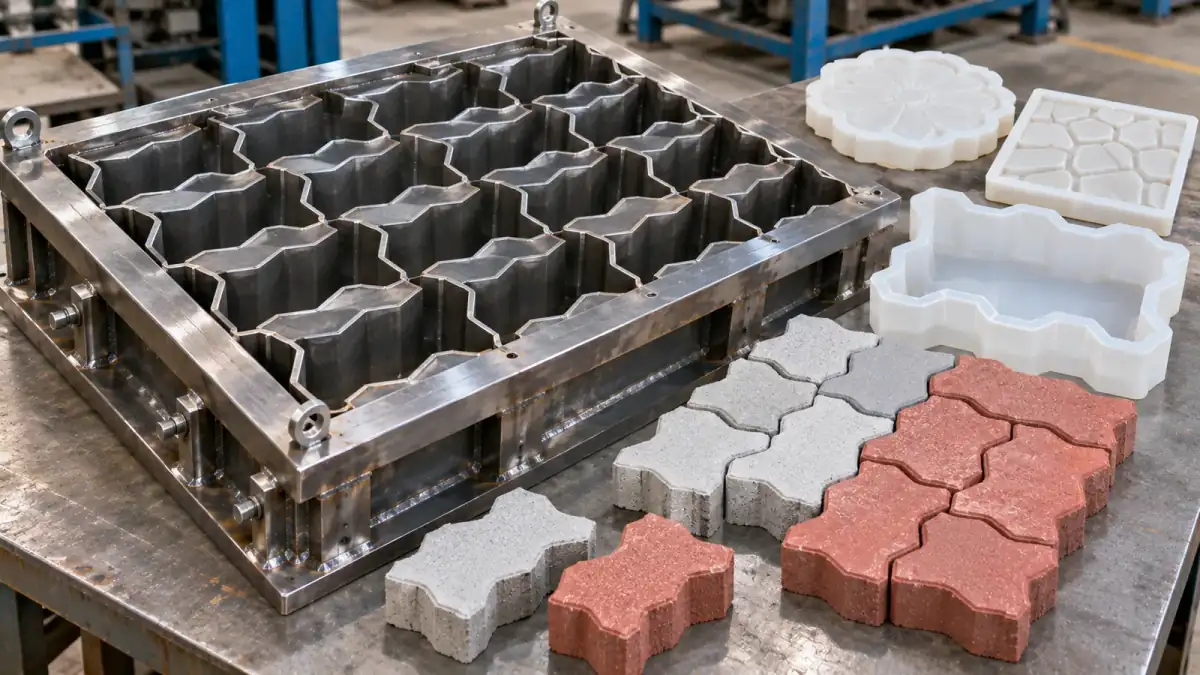
Paver molds fall into two worlds. Homeowners pour concrete into plastic stepping-stone molds; paving companies press thousands of interlocking pavers an hour with steel moulds on a block machine. Both search for “concrete paver molds” — here is how they differ.
Types of concrete paver molds
| Mold type | Process | Output | Typical strength | Best for |
|---|---|---|---|---|
| Plastic (ABS/PVC) molds | Wet-cast, vibrating table optional | One paver per mold per day | Moderate | Small workshops, decorative tiles |
| Rubber / silicone molds | Wet-cast | One per day, fine detail | Moderate | Stone-look and cobblestone pavers |
| Walkway / path molds | Pour-in-place pattern forms | A few m² per day | Depends on mix | DIY garden paths |
| Steel machine moulds | Vibro-pressed earth-moist concrete | Thousands of pavers per hour on automatic lines | High (commercial standards) | Commercial interlocking pavers |
Machine paver moulds
A machine paver mould has a mould box with many cavities (for example dozens of 200×100 mm rectangular pavers per cycle on large machines) and a tamper head with shoes for each cavity. Shoes can be flat, textured, chamfered or carry a logo. Our paving and interlocking brick mould covers Holland (rectangular), zigzag, I-shape, hexagonal and custom shapes. Thicknesses of 60 mm (pedestrian), 80 mm (driveways, light traffic) and 100 mm (heavy traffic) are common.
Cobblestone, stone-look and large pavers
Tumbled and cobblestone looks can be made by machine (with a tumbling drum after curing) or wet-cast in rubber molds. Large-format slabs (e.g. 400×400 or 600×300 mm) need a machine with enough mould area and a strong press, or a separate hydraulic press.
Stepping stone molds
Stepping stone and garden path molds are a DIY category: pour a wetter mix, tap out air, cure under plastic for 24–48 hours. They are useful for one-off garden work but cannot compete with machine pavers on cost or strength for driveways.
Coloured pavers
Add iron oxide pigment at about 3–5% of cement weight. On machines with a face-mix feeder, colour only the top layer (around 5–10 mm), cutting pigment use substantially — see how paver blocks are made.
Machines for this application
- Paving & Interlocking Brick Mould — Precision paver moulds with textured tamper heads for Holland, zigzag, I-shape and custom paving stones.
- QT12-15 Automatic Block & Colour Paver Machine — Large-capacity automatic plant: 12 hollow blocks every 15 seconds, 36 kW total power and a 250–300 m² workshop footprint.
- Iron Oxide Pigment for Concrete Blocks & Pavers — Fe₂O₃ powder pigments in red, yellow, black, brown and blue for colour pavers, roof tiles and blocks — 25 kg bags.
Need paver moulds for your machine?
Send your target daily output, product sizes, local raw materials and voltage. Our engineers reply within 24 hours with a recommended configuration, layout and itemised quotation.
Frequently asked questions
What are the best molds for concrete pavers?
For commercial production, heat-treated steel machine moulds on a vibro-press machine. For DIY, durable ABS plastic or rubber molds.
How thick should concrete pavers be?
About 60 mm for pedestrian areas, 80 mm for driveways and 100 mm or more for heavy traffic.
Can I put a logo on pavers?
Yes. The tamper head of a machine mould can be engraved with a logo or texture.
Related guides
- How Paver Blocks Are Made: Mix, Moulding, Two-Layer Colour and Curing
- Concrete Block Molds: Machine Moulds, Steel Grades, Mould Life and Custom Shapes
- Types of Concrete Blocks: 15 Block Types, Their Uses and the Moulds That Make Them
- Concrete Curb Machine Guide: Slipform Curbing Machines vs Precast Curbstone Machines