Key takeaways
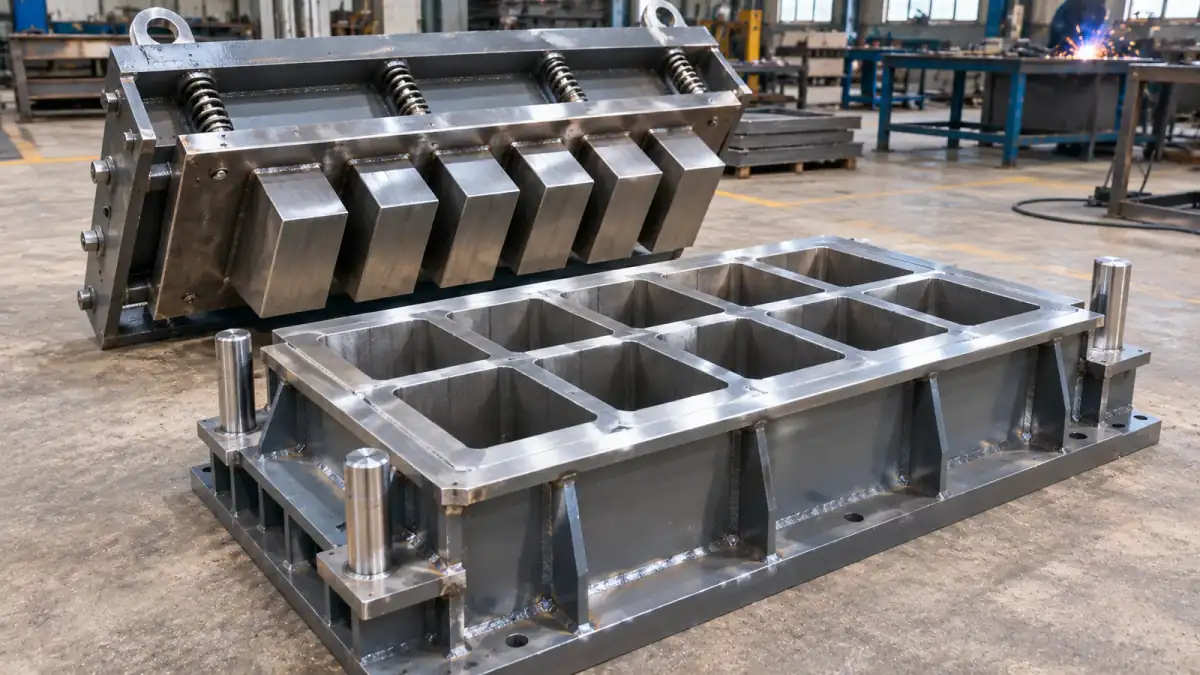
- A block machine mould has two parts: the mould box (with cores) and the tamper head; both wear and must match the machine exactly.
- Wear-resistant steel, carburising and quenching or nitriding determine mould life — our heat-treated moulds are rated for more than 80,000 cycles.
- DIY plastic or wooden forms are for wet-cast single blocks, not for machine production.
- Budget a spare mould for your best-selling block.
“Concrete block molds for sale” can mean a plastic garden form or a two-tonne steel mould for an automatic line. For producers, the mould is the part that defines product shape, dimensional accuracy and — through wear — part of your cost per block.
Types of concrete block molds
| Type | Concrete | Output | Use |
|---|---|---|---|
| Block machine mould (steel) | Earth-moist, vibrated and pressed | Hundreds to thousands of blocks per hour | Commercial block, paver, curb production |
| Egg-laying machine mould | Earth-moist | Blocks laid on floor | Mobile block making |
| Wet-cast steel forms | Flowable concrete | One unit per form per day | Large blocks, architectural pieces |
| Plastic / silicone / wood forms | Wet concrete | One unit per form per day | DIY, garden and craft products |
Parts of a block machine mould
- Mould box (lower mould): the frame and cavities, including core bars for hollow blocks.
- Tamper head (upper mould): press shoes that enter each cavity to compress and strip the blocks.
- Liners and wear plates on high-output moulds, replaceable without changing the whole box.
Steel and heat treatment
Abrasive sand and stone wear cavity walls and press shoes every cycle. Wear-resistant plate (e.g. NM400-class steel), carburising, quenching and nitriding harden the working surfaces. Our heat-treated concrete block mould is made this way and rated for more than 80,000 cycles. Cheap untreated moulds wear quickly, and blocks grow in size or lose sharp edges.
Mould life and cost per block
Mould cost per block = mould price ÷ (guaranteed cycles × blocks per cycle). A treated mould that lasts twice as long often costs far less per block than a cheaper one. Measure cavities regularly and replace before dimensions drift out of tolerance.
Custom moulds
Common custom requests: local hollow block sizes (e.g. 8×8×16 in, 400×200×150 mm), retaining-wall blocks with a rear lip, interlocking wall blocks, hourdis, curbstones, grass pavers, and logos on paver faces. Send a dimensioned drawing or a photo with measurements and the machine model; mould and pallet sizes must match.
How to make a concrete block mold (DIY)
For a one-off project you can build a wooden form from plywood with removable cores wrapped in plastic, oil it, fill with wet concrete and strip after 24 hours. Expect slow output and lower strength than machine blocks — fine for a garden, not for a business.
Moulds and pallets go together
Every machine mould sits on a pallet; pallet flatness affects block height. See the pallet comparison and paver moulds.
Machines for this application
- Heat-Treated Concrete Block Mould — NM400 wear-resistant moulds, carburised, nitrided and quenched for more than 80,000 cycles.
- Paving & Interlocking Brick Mould — Precision paver moulds with textured tamper heads for Holland, zigzag, I-shape and custom paving stones.
- GMT Glass-Fibre Block Machine Pallet — Glass-fibre reinforced thermoplastic pallets with double-polished surfaces (1.00 mm flatness) and an 8-year warranty.
Send your block drawing for a mould quotation
Send your target daily output, product sizes, local raw materials and voltage. Our engineers reply within 24 hours with a recommended configuration, layout and itemised quotation.
Frequently asked questions
How long does a concrete block mould last?
It depends on steel, heat treatment and aggregates. Our heat-treated moulds are rated for more than 80,000 cycles.
Can I buy a mould for my existing block machine?
Yes, if you provide the machine model, pallet size and block drawing so the mould fits exactly.
What is the best material for concrete block molds?
For machine production, wear-resistant steel with carburising, quenching or nitriding. Plastic and wood are only for wet-cast DIY forms.