Key takeaways
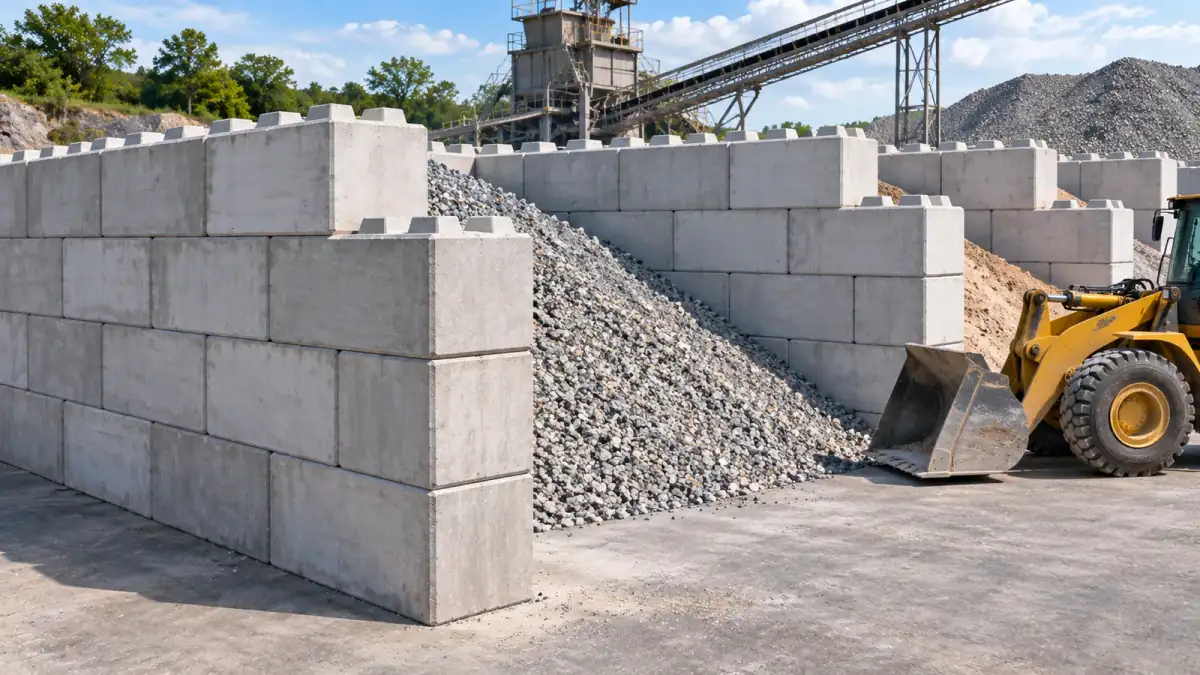
- Large interlocking blocks (often 2×2×6 ft, about 600×600×1,800 mm) weigh around 1.5–2 tonnes each and stack without mortar.
- They are wet-cast in steel forms, not made on block machines, and are a classic way for ready-mix plants to use returned concrete.
- Uses: bin walls for aggregates, retaining walls, flood and security barriers, temporary walls.
Large interlocking concrete blocks — sometimes called ecology blocks, bin blocks or jumbo blocks — are giant stackable units with lugs on top and recesses underneath. Contractors use them to build walls fast with a loader or excavator.
Common sizes and weights
| Size (ft) | Approx. mm | Approx. weight |
|---|---|---|
| 2 × 2 × 6 | 600 × 600 × 1,800 | about 1.6–1.8 t |
| 2 × 2 × 4 | 600 × 600 × 1,200 | about 1.1–1.2 t |
| 2 × 2 × 3 (half) | 600 × 600 × 900 | about 0.8–0.9 t |
| 2 × 2 × 2 (cube) | 600 × 600 × 600 | about 0.5–0.6 t |
Weights assume normal-weight concrete at about 2,400 kg/m³ and vary with lug design.
Uses
- Aggregate and material storage bays (bin walls)
- Gravity retaining walls
- Flood defences and site security barriers
- Temporary walls on construction sites
Concrete block forms
Large blocks are wet-cast: a steel form (often with a hinged or tapered side) is filled with flowable concrete, left to harden overnight, then stripped. Lifting loops or a slot for forklift tines are cast in. Many ready-mix producers keep a row of forms next to the plant to turn returned or leftover concrete into saleable blocks instead of waste.
Large forms vs block machine moulds
A block machine mould forms small units from dry, earth-moist concrete in seconds and demoulds immediately. Large-block forms hold wet concrete for hours. If you want to make retaining-wall units of normal masonry size at volume, a block machine with retaining-wall block moulds is more productive; for jumbo units, use steel forms. See also concrete block retaining walls.
Machines for this application
- Heat-Treated Concrete Block Mould — NM400 wear-resistant moulds, carburised, nitrided and quenched for more than 80,000 cycles.
- ZL946 Front-End Wheel Loader — Wheel loader with 1.7 m³ bucket for aggregate and raw-material handling in block plants and quarries.
Need forms or moulds for large blocks?
Send your target daily output, product sizes, local raw materials and voltage. Our engineers reply within 24 hours with a recommended configuration, layout and itemised quotation.
Frequently asked questions
How much does a 2×2×6 concrete block weigh?
Roughly 1.6–1.8 tonnes in normal-weight concrete.
How are large interlocking concrete blocks made?
Wet concrete is poured into steel forms, left to harden, then stripped; they are not made on block machines.
What are 2×2×6 blocks used for?
Bin walls, retaining walls, barriers and temporary walls.
Related guides
- Concrete Block Molds: Machine Moulds, Steel Grades, Mould Life and Custom Shapes
- Concrete Block Retaining Walls: Block Types, Design Basics and Retaining Wall Block Production
- Interlocking Concrete Blocks: Types, Uses in Home Construction and How They Are Made
- Types of Concrete Blocks: 15 Block Types, Their Uses and the Moulds That Make Them