Key takeaways
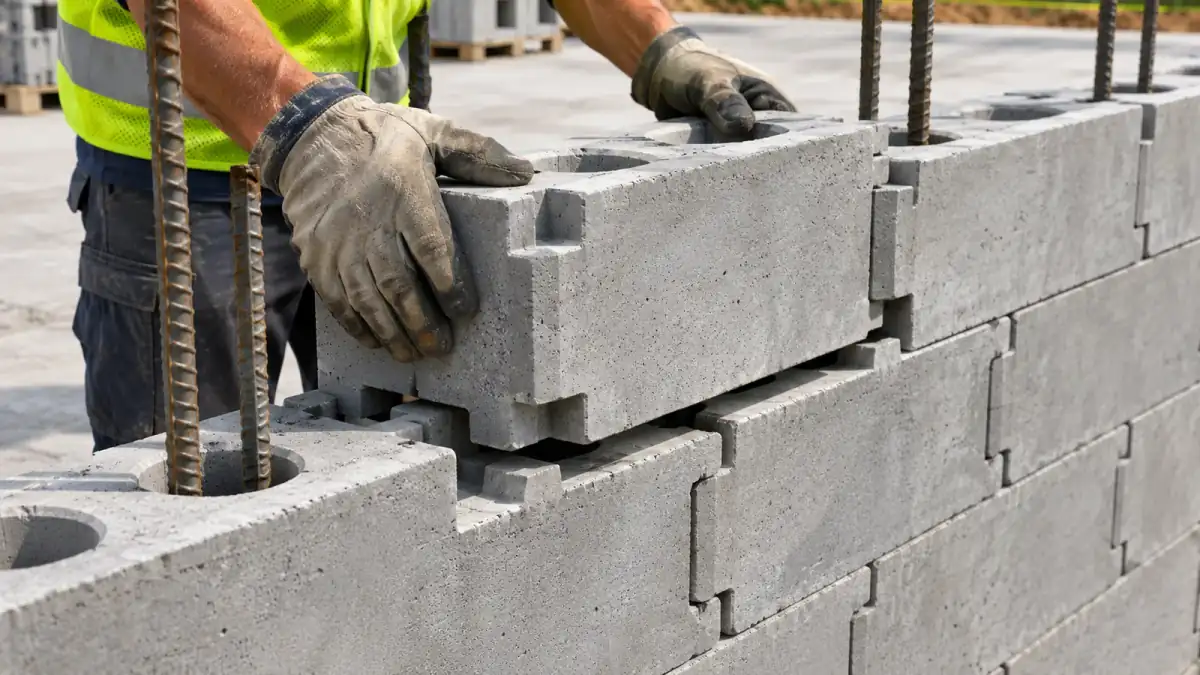
- “Interlocking block” covers three products: mortarless wall blocks, interlocking paving stones and large interlocking retaining or barrier blocks.
- Mortarless wall systems speed up construction and cut mortar use, but need accurate block dimensions.
- Interlocking concrete blocks are made on vibro-press block machines with special moulds; interlocking soil bricks on CEB presses.
Interlocking blocks have keys, tongues or lugs that lock them into neighbouring units. The idea is old, but precise machine-made blocks have made it practical at scale.
Three kinds of interlocking concrete blocks
- Mortarless (dry-stack) wall blocks — hollow or solid blocks with interlocking profiles; vertical cores take reinforcement and grout. Used for houses, boundary walls and low-cost housing.
- Interlocking pavers — zigzag, I-shape, hexagonal and other shapes that lock in plan to spread traffic loads. See how paver blocks are made.
- Large interlocking blocks — 2×2×6 ft and similar units for bin walls, retaining walls and barriers. See large concrete block forms.
Interlocking concrete blocks for home construction
Advantages: faster laying (less skill needed), lower mortar and plaster use, straight and plumb walls, easy reinforcement in aligned cores.
Limitations: blocks must be dimensionally precise (height tolerance is critical), building codes in some countries still require mortar joints, and the first course must be perfectly level.
Interlocking concrete vs interlocking earth bricks
Interlocking earth bricks (CEB) use soil with a little cement; interlocking concrete blocks use cement, sand and stone. Concrete versions are stronger; earth versions are cheaper where soil is suitable. Full comparison: interlocking clay bricks vs concrete blocks.
How interlocking concrete blocks are made
Mortarless wall blocks and pavers are formed on vibro-press block machines with interlocking moulds; the hydraulic pressing of machines like the QT4-23A or any automatic QT line keeps block height consistent, which is essential for dry-stacking. Interlocking soil bricks are produced on interlocking brick machines. Moulds: paving and interlocking brick moulds.
Machines for this application
- QT4-23A Semi-Automatic Hydraulic Block Machine — Hydraulic-assisted semi-automatic machine with a 24-second cycle — up to 6,720 blocks a day in a 60 m² workshop.
- Paving & Interlocking Brick Mould — Precision paver moulds with textured tamper heads for Holland, zigzag, I-shape and custom paving stones.
- QTS5-10 Automatic Interlocking Clay Brick Machine — Automatic hydraulic compressed earth brick machine: 16 MPa forming pressure, 7.5 kW and a 10-second cycle.
Want to produce interlocking blocks?
Send your target daily output, product sizes, local raw materials and voltage. Our engineers reply within 24 hours with a recommended configuration, layout and itemised quotation.
Frequently asked questions
Do interlocking concrete blocks need mortar?
Mortarless systems are dry-stacked, usually with grout and reinforcement in some cores and a mortar bed for the first course. Local codes may require mortar.
Are interlocking blocks cheaper?
They can reduce mortar, plaster and labour, though the blocks themselves may cost slightly more due to precision.
Which machine makes interlocking blocks?
Concrete interlocking blocks and pavers are made on block machines with interlocking moulds; soil interlocking bricks on CEB presses.