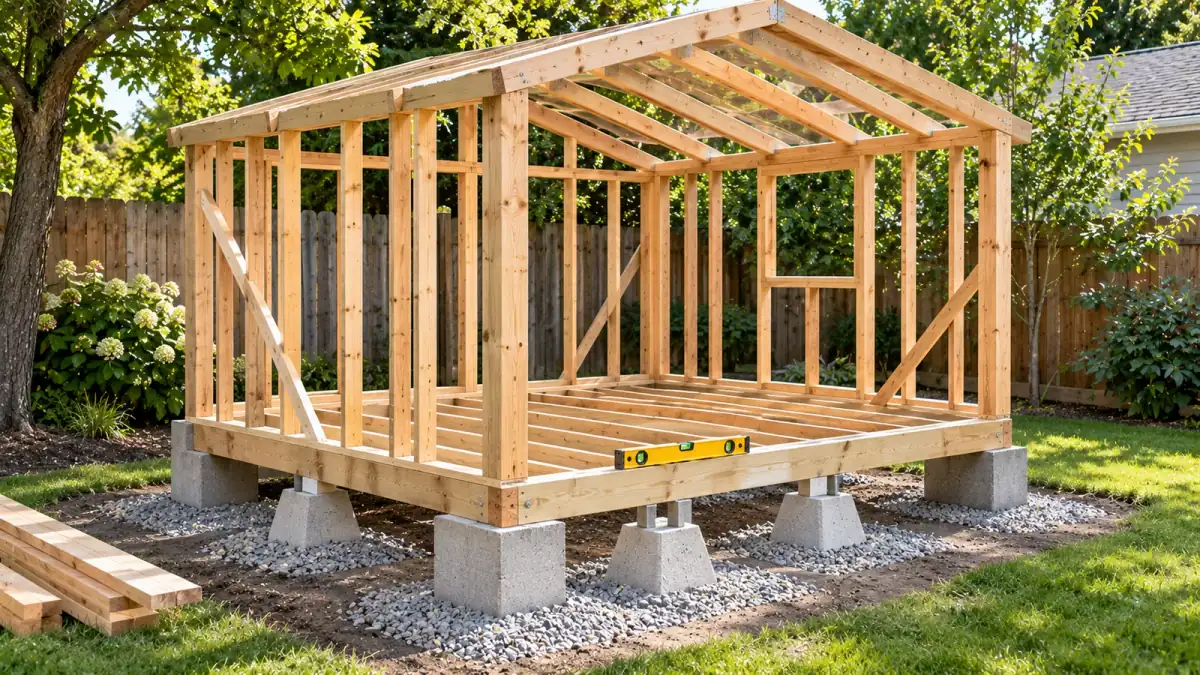
Key takeaways
- Shed foundations on blocks use solid concrete blocks or pier blocks on compacted gravel pads, spaced under the floor joists.
- A small shed typically needs 6–12 support points; larger sheds need more rows.
- Deck and pier blocks with a 4×4 or 6×6 post socket are popular high-margin precast items.
- Solid and pier blocks are made on standard block machines with a specific mould.
Foundation blocks support sheds, decks, cabins and fences without a full concrete slab. They are also an easy, profitable product line for block producers.
Types of foundation blocks
| Block | Typical size | Use |
|---|---|---|
| Solid concrete block | 4×8×16 or 8×8×16 in; 400×200×100 mm | Shed and cabin supports |
| Patio / paving slab | 16×16 in; 400×400 mm | Spread loads under blocks |
| Deck pier block | About 11×11×8 in with post socket | Deck and post support |
| Hollow foundation block | 8×8×16 or 12×8×16 in | Foundation walls (grouted) |
| Fence post block | Varies | Temporary and permanent fencing |
Building a shed foundation on concrete blocks
- Mark the shed footprint and support locations under the floor beams (typically every 1.2–1.8 m).
- Dig out topsoil at each point; add 100–150 mm of compacted gravel.
- Set a paving slab or solid block on each pad; level across the site with a string line and spirit level.
- Stack solid blocks (never hollow blocks with cores vertical under point loads unless filled) to reach height; shim with solid caps, not wood scraps.
- Place floor beams and check level and diagonal measurements.
A 2.4×3.0 m (8×10 ft) shed usually needs about 6–9 support points — two or three rows of three.
When blocks are not enough
Large or heavy buildings, frost-prone ground, slopes and soft soils need engineered footings or a slab. Houses need proper foundations — see block house construction.
Producing foundation and pier blocks
Solid blocks and pier blocks are formed on any vibro-press machine with the right mould — small machines like the QTJ4-26 or automatic QT4-15 work well. Garden centres and builders' merchants buy them in volume, and they use little cement relative to their price.
Machines for this application
- Heat-Treated Concrete Block Mould — NM400 wear-resistant moulds, carburised, nitrided and quenched for more than 80,000 cycles.
- QT4-15 Automatic Hydraulic Block Making Machine — Entry-level fully automatic block machine with PLC control and hydraulic pressing — the lowest-cost way to move from manual to automatic production.
- QTJ4-26 Small Block Making Machine — Compact machine with platform + mould vibration (4,500–5,100 rpm) — a reliable small-business block maker.
Add foundation and pier blocks to your range
Send your target daily output, product sizes, local raw materials and voltage. Our engineers reply within 24 hours with a recommended configuration, layout and itemised quotation.
Frequently asked questions
Can I use concrete blocks for a shed foundation?
Yes, for small and medium sheds on firm, well-drained ground, using solid blocks on compacted gravel pads.
How many concrete blocks do I need for a shed foundation?
Usually 6–12 support points for a small shed, each with one or more blocks depending on height.
Should I use hollow or solid blocks under a shed?
Solid blocks are preferred for point loads.
Related guides
- Types of Concrete Blocks: 15 Block Types, Their Uses and the Moulds That Make Them
- Hollow vs Solid Concrete Blocks: Strength, Weight, Cost and Production
- Concrete Block House Construction: Costs, Block Quantities, Pros and Cons
- Concrete Block Molds: Machine Moulds, Steel Grades, Mould Life and Custom Shapes