Key takeaways
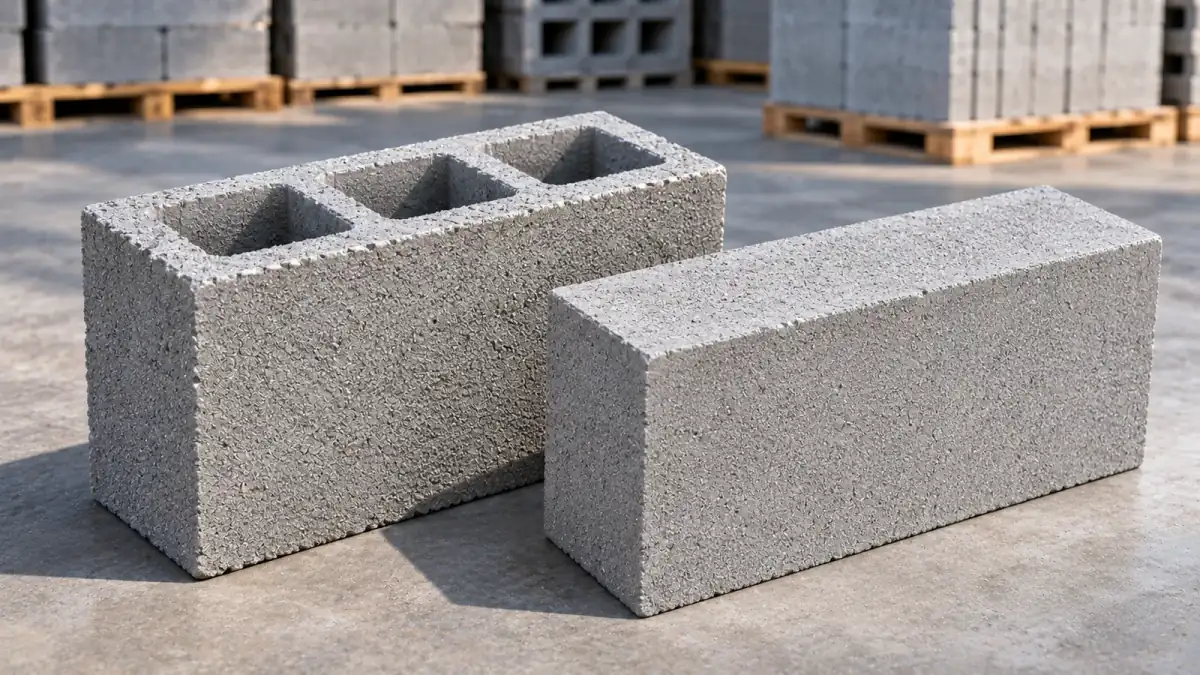
- Hollow blocks have about 25–50% void area; solid blocks have little or none (ASTM treats units with at least 75% net area as solid).
- Hollow blocks use less material, weigh less, are faster to lay and can be reinforced and grouted.
- Solid blocks carry concentrated loads, resist fire and sound better and suit foundations and piers.
- Both are made on the same machine; only the mould changes.
The hollow block is the workhorse of concrete masonry worldwide — in the Philippines it is the CHB, in West Africa the “6-inch block”. Solid blocks cover the jobs where mass and bearing area matter. Here is how they compare.
The difference
A hollow concrete block has two or three vertical cores. A solid concrete block has no cores or only small frogs. In ASTM terms, a unit with a net cross-sectional area of at least 75% of its gross area is “solid”.
Comparison
| Hollow block | Solid block | |
|---|---|---|
| Material per block | Lower | Higher |
| Weight | Lighter, faster to lay | Heavier |
| Gross compressive capacity | Good; can be raised by grouting cores | Higher |
| Reinforcement | Rebar + grout in cores | Not possible in the unit |
| Thermal insulation | Air cores help; can be filled with insulation | More thermal mass |
| Sound insulation | Lower | Higher |
| Typical uses | Walls, partitions, reinforced masonry | Foundations, piers, fire and party walls, below grade |
Production differences
Both come off the same machine. Hollow blocks need a mould with core bars and a vibration setting that fills thin face shells; solid blocks need more material per cycle and slightly longer vibration. A 400×200×200 mm hollow block machine rated at 4 blocks per cycle — like the QT4-45 hollow block machine — will usually make the same number of solid blocks of that size per cycle, or many more small solid bricks.
Mix design
Thin face shells are sensitive to aggregate size: keep coarse aggregate at or below about 10 mm for hollow blocks. See the mix ratio guide for starting recipes.
Which to produce?
Most yards produce mainly hollow blocks and add solid blocks for foundations, plus footing and pier blocks. Ask your local builders which sizes sell, then order moulds to match.
Machines for this application
- QT4-45 Hollow Block Machine — Robust electric vibration block machine producing 400 × 200/150/100/250 mm blocks with a 40-second cycle.
- QT4-23A Semi-Automatic Hydraulic Block Machine — Hydraulic-assisted semi-automatic machine with a 24-second cycle — up to 6,720 blocks a day in a 60 m² workshop.
- QT10-15 Fully Automatic Block Production Line — High-output automatic line producing 10 hollow blocks per cycle, designed to use fly ash and industrial by-products to lower raw-material cost.
Producing hollow and solid blocks?
Send your target daily output, product sizes, local raw materials and voltage. Our engineers reply within 24 hours with a recommended configuration, layout and itemised quotation.
Frequently asked questions
Are hollow blocks weaker than solid blocks?
Per unit, yes, but hollow block walls can be reinforced and grouted to exceed the capacity of solid block walls.
Why use hollow concrete blocks?
They use less material, weigh less, are faster to lay and allow reinforcement and services in the cores.
Can a hollow block machine make solid blocks?
Yes, by changing the mould.
Related guides
- Types of Concrete Blocks: 15 Block Types, Their Uses and the Moulds That Make Them
- Concrete Block Sizes and Dimensions: Imperial and Metric Size Chart
- Concrete Block Mix Ratio: Proven Recipes for Hollow Blocks, Solid Bricks and Pavers
- How Are Concrete Blocks Made? The Block Production Process Step by Step