Key takeaways
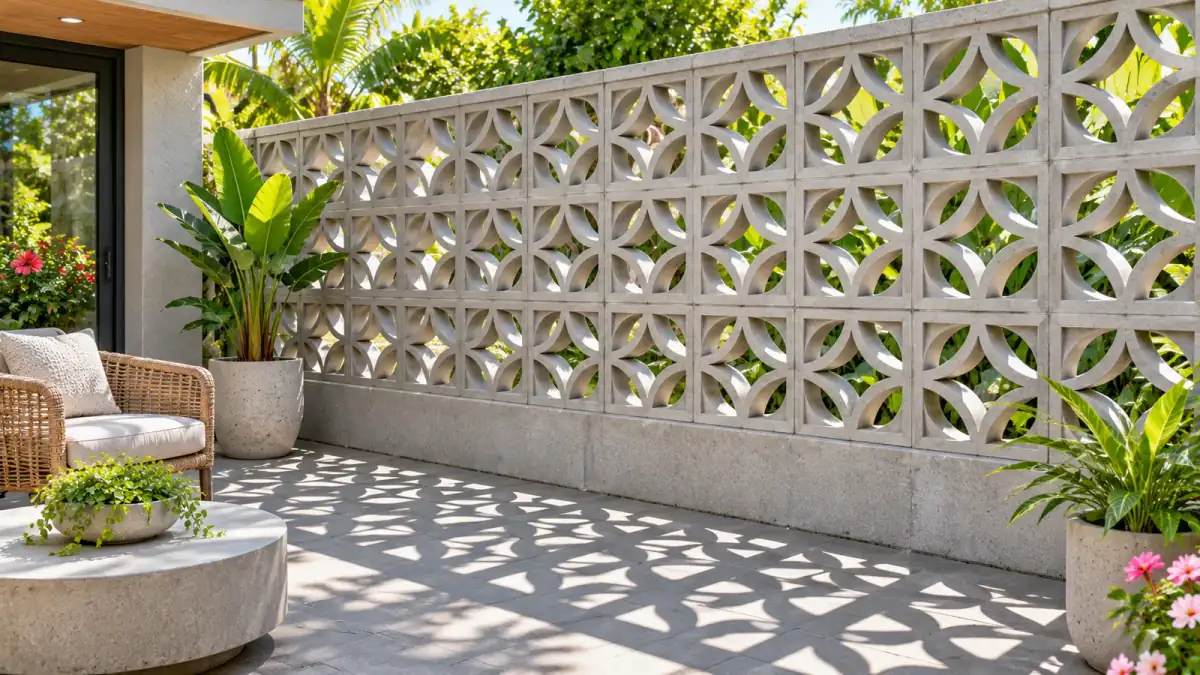
- Breeze blocks are open-pattern concrete screen blocks that let air and light through while giving privacy and shade.
- Split-face, ribbed and coloured blocks give walls an architectural finish without plaster or paint.
- Machine-pressed screen blocks need precise moulds; some patterns are wet-cast instead.
- Decorative blocks usually command higher prices than plain blocks — a margin opportunity for producers.
“Breeze block” means two things depending on where you live. In the UK it is an old name for any lightweight concrete block (originally made with “breeze” — cinders). In the US, Australia and much of the tropics it means the decorative perforated screen block made famous by mid-century modern architecture. This article covers the decorative meaning and other architectural blocks.
Breeze (screen) blocks
- Typical size around 300×300 mm or 12×12 in, 100–150 mm thick; also 400×200 mm modular patterns.
- Patterns: circles, diamonds, flowers, waves, crosses, squares.
- Uses: privacy walls, fences, facade shading, stair screens, garden walls, ventilation in hot climates.
- Laying: stack-bonded with mortar, often with steel reinforcement in joints or pilasters for stability.
Split-face and facing blocks
Split-face blocks are cast as a double unit and split by a hydraulic splitter, exposing a rough stone-like texture. Facing blocks may also be ribbed, scored, polished or shot-blasted. They form the finished face of commercial buildings, fences and site walls.
Concrete block colours
Colour comes from iron oxide pigments (reds, browns, yellows, black) and chromium oxide (green), typically dosed at a few percent of cement weight. Use consistent cement and sand to keep colour uniform between batches; see our iron oxide pigment.
Decorative concrete block fences and walls
Popular designs combine solid pillars of split-face or coloured block with breeze-block infill panels and capping units on top. Reinforce pillars with rebar and grout, especially for walls above about 1.2 m or in windy or seismic areas.
How decorative blocks are produced
| Product | Production method |
|---|---|
| Breeze/screen blocks | Vibro-pressed with special moulds, or wet-cast in steel/plastic moulds for complex patterns |
| Split-face blocks | Block machine + hydraulic block splitter |
| Ribbed/fluted blocks | Block machine with ribbed mould |
| Coloured blocks | Pigment dosing in the mix or face mix |
Moulds: concrete block molds. A standard automatic machine such as the QT4-15 can switch between plain and decorative blocks in under an hour.
Machines for this application
- Heat-Treated Concrete Block Mould — NM400 wear-resistant moulds, carburised, nitrided and quenched for more than 80,000 cycles.
- Iron Oxide Pigment for Concrete Blocks & Pavers — Fe₂O₃ powder pigments in red, yellow, black, brown and blue for colour pavers, roof tiles and blocks — 25 kg bags.
- QT4-15 Automatic Hydraulic Block Making Machine — Entry-level fully automatic block machine with PLC control and hydraulic pressing — the lowest-cost way to move from manual to automatic production.
Want to make breeze blocks or split-face blocks?
Send your target daily output, product sizes, local raw materials and voltage. Our engineers reply within 24 hours with a recommended configuration, layout and itemised quotation.
Frequently asked questions
What is a breeze block?
Today usually a decorative open-pattern concrete screen block; in the UK the term also refers to lightweight concrete blocks.
Are breeze blocks strong?
They are non-load-bearing screens; walls need pillars and reinforcement for stability.
How are split-face blocks made?
A double block is pressed on a block machine, cured, then split by a hydraulic splitter to expose a rough face.
Related guides
- Types of Concrete Blocks: 15 Block Types, Their Uses and the Moulds That Make Them
- Concrete Block Wall Finishes: Stucco, Paint, Sealers, Cladding and Architectural Blocks
- Concrete Block Molds: Machine Moulds, Steel Grades, Mould Life and Custom Shapes
- Concrete Paver Molds: Machine Moulds vs Plastic Molds for Paving Stones