Key takeaways
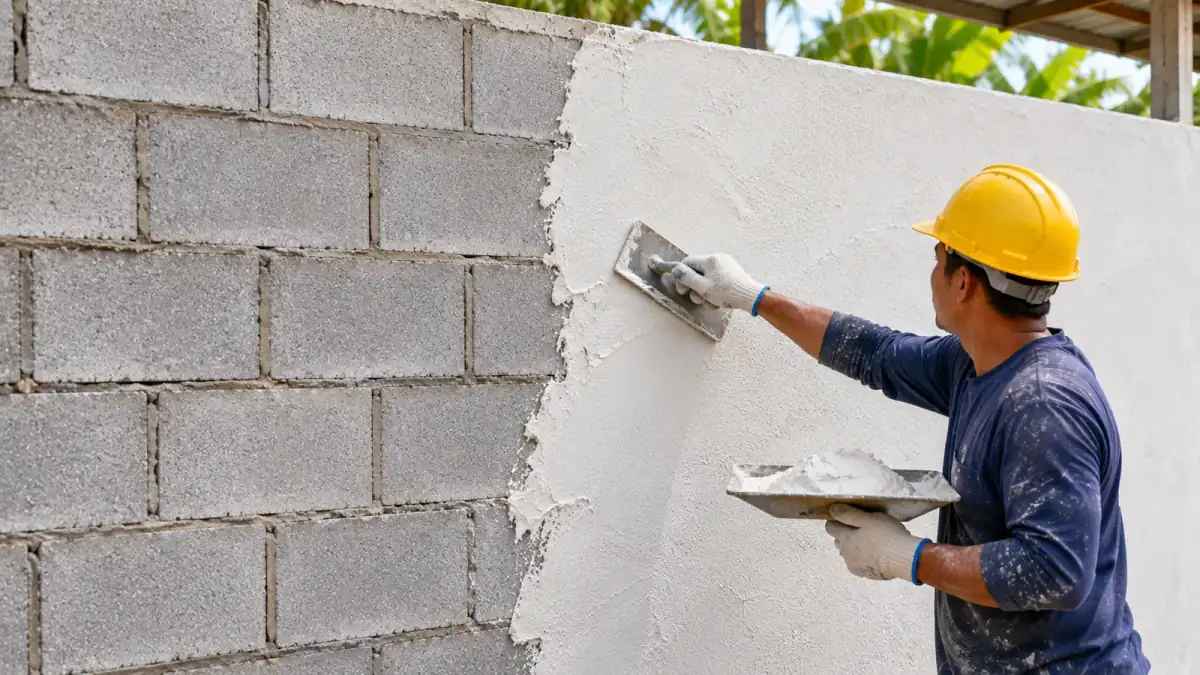
- Stucco/render is the most common finish: scratch coat, brown coat and finish coat, or a one-coat system.
- Use breathable masonry paints or elastomeric coatings; seal basements with cementitious or penetrating sealers plus exterior waterproofing.
- The cheapest durable cover is usually render plus masonry paint.
- Split-face, coloured and ribbed blocks avoid render altogether — a value-added product for producers.
Grey block walls are honest but not always pretty. Here are the finishing options, from cheapest to most architectural.
Finish options compared
| Finish | Cost | Notes |
|---|---|---|
| Masonry paint | Low | Prime with block filler to fill pores |
| Stucco / cement render | Low–medium | Durable; weather-tight; many textures |
| Elastomeric coating | Medium | Bridges hairline cracks |
| Stone or brick veneer | High | Needs ties or adhered system |
| Siding / cladding on battens | Medium–high | Allows insulation behind |
| Architectural blocks (split-face, coloured) | Built in | No further finish needed |
Stucco on concrete block
Clean the wall, dampen, apply a scratch coat (about 10 mm), then a brown coat and finish coat — or a polymer-modified one-coat system. Keep render moist for several days. Control joints in the block wall should continue through the render.
Painting concrete blocks
Use a block filler primer, then acrylic masonry paint or elastomeric coating. Stone-look effects can be achieved with sponging and multiple tones, though architectural blocks give a longer-lasting result.
Sealing block walls and basements
- Outside, below grade: dampproofing or waterproofing membrane plus drainage at the footing.
- Inside basements: cementitious waterproof coatings or penetrating (silane/siloxane) sealers; address water sources first.
- Above grade: breathable water repellents on fair-faced blocks.
Finish-ready blocks
Split-face, ribbed, polished and coloured blocks make walls that look finished from day one. They are produced on standard block machines with special moulds, a splitter and pigments. More in decorative concrete blocks.
Machines for this application
- Iron Oxide Pigment for Concrete Blocks & Pavers — Fe₂O₃ powder pigments in red, yellow, black, brown and blue for colour pavers, roof tiles and blocks — 25 kg bags.
- Heat-Treated Concrete Block Mould — NM400 wear-resistant moulds, carburised, nitrided and quenched for more than 80,000 cycles.
Produce finish-ready architectural blocks
Send your target daily output, product sizes, local raw materials and voltage. Our engineers reply within 24 hours with a recommended configuration, layout and itemised quotation.
Frequently asked questions
What is the cheapest way to cover concrete block walls?
Usually cement render (stucco) followed by masonry paint, or paint alone with a block filler primer.
Can you stucco directly over concrete block?
Yes. Concrete block is an excellent stucco base; clean and dampen it first.
How do I seal a cinder block basement wall?
Fix drainage first, then apply cementitious waterproofing or penetrating sealers inside and membranes outside where possible.
Related guides
- Breeze Blocks and Decorative Concrete Blocks: Designs, Uses and Manufacturing
- Concrete Block Wall Construction: Footings, Mortar, Laying and Reinforcement
- Types of Concrete Blocks: 15 Block Types, Their Uses and the Moulds That Make Them
- Concrete Block House Construction: Costs, Block Quantities, Pros and Cons